
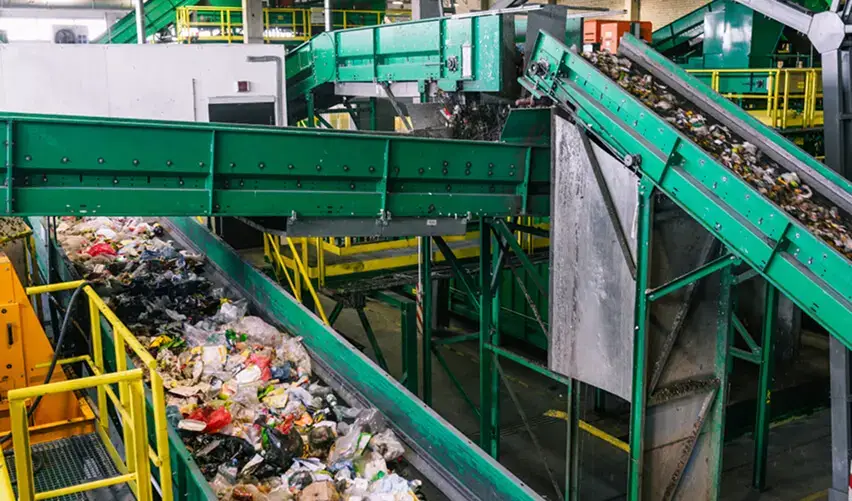
The Journey Begins: Collection & Initial Sorting
Plastic recycling is a highly sophisticated industrial process that transforms discarded consumer and industrial plastics back into valuable raw materials. The journey begins long before the plastic reaches a processing facility.
Once collected from municipal streams, industrial scrap lines, or e-waste disassembly plants, bulk plastics are transported to a Material Recovery Facility (MRF). Here, the initial bulk sorting takes place. Large debris, non-plastic contaminants (like metals and glass), and hazardous materials are removed, often utilizing a combination of manual inspection and automated screens.
Why Initial Sorting Matters
Contamination is the enemy of high-quality recycling. If a single PVC (Polyvinyl Chloride) bottle slips into a batch of PET (Polyethylene Terephthalate), it can chemically compromise an entire silo of recycled resin, rendering it unusable for high-grade manufacturing.
Shredding and Friction Washing
Once the plastics are roughly sorted by type, they cannot simply be melted down. They are first fed into heavy-duty industrial granulators that tear and cut the material into small, uniform pieces known as "flakes."
These flakes are heavily contaminated with residues, glues, paper labels, and dirt. To address this, the flakes enter intense friction washers. Using high-speed agitation and sometimes hot water or mild detergents, the friction generated between the flakes themselves scrubs away the exterior impurities.
Advanced Separation Technologies
Even after washing, the flakes are often a mix of different plastic polymers that must be separated to achieve the purity required by manufacturers.
| Technology | Mechanism | Primary Use Case |
|---|---|---|
| Float-Sink Tanks | Density-based separation using water mediums. | Separating dense plastics (PET, PVC) which sink, from lighter plastics (HDPE, PP) which float. |
| NIR Optical Sorting | Near-Infrared light detects the unique polymer signature of the flake. | Identifying and ejecting specific, unwanted polymers from a high-speed conveyor belt using air jets. |
| Electrostatic Sorting | Induces a static charge; different plastics react differently to the charge. | Separating complex mixtures from e-waste, such as separating ABS from polystyrene. |
Melting, Compounding & Extrusion
The pure, clean, and dried flakes are now ready to be transformed back into a raw material. They are fed into an extruder—a massive heated barrel containing a rotating screw. The heat and friction melt the flakes into a continuous, viscous polymer melt.
During this melting phase, the liquid plastic is pushed through ultra-fine screens to filter out any microscopic contaminants that survived the washing process. Manufacturers may also use this compounding stage to introduce specific additives—like UV stabilizers, colorants, or impact modifiers—to tailor the plastic to the buyer's exact specifications.
"The extrusion process is where waste officially ceases to be waste, reforming at a molecular level into a certified, high-performance manufacturing input."
Pelletizing and Reintegration
As the molten plastic exits the extruder, it is pushed through a die plate (resembling a showerhead) to form long strands. These strands are immediately cooled in a water bath and chopped by rotary blades into tiny, uniform pellets known as "nurdles."
These pellets undergo strict quality assurance testing to verify their melt flow index, tensile strength, and purity. Once certified, they are bagged and shipped to injection molding and thermoforming facilities worldwide, ready to be shaped into everything from automotive dashboards to consumer packaging, completing the circular lifecycle.
Key Takeaways
- The mechanical recycling process involves collection, sorting, shredding, washing, melting, and pelletizing.
- Removing contamination early is critical; a single incorrect polymer can ruin an entire batch of recycled resin.
- Float-sink tanks and Near-Infrared (NIR) optical scanners are standard for separating mixed plastic flakes by density and polymer type.
- During extrusion, microscopic impurities are filtered out, and necessary chemical additives can be introduced.
- The final output—uniform plastic pellets—serves as a direct, sustainable replacement for virgin plastics in industrial manufacturing.