
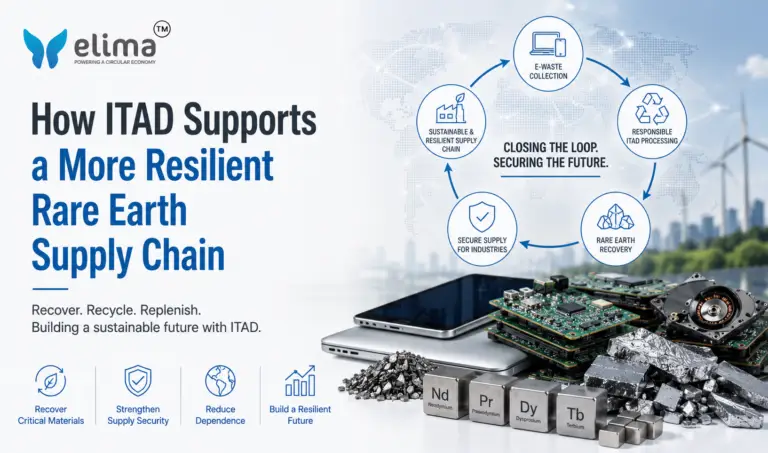
The devices we use every day contain more than just technology.
Inside laptops, servers, hard drives, networking equipment, speakers, displays and other electronic products are metals and materials that make modern technology possible. Some of these include critical minerals and rare earth elements that are used in electronics, permanent magnets, electric motors and other advanced applications.
As demand for technology continues to increase, securing reliable access to these materials has become an important global challenge.
This raises an interesting question:
Can the products we have already manufactured become a source of materials for the products we need tomorrow?
This is where IT Asset Disposition (ITAD) can play a role.
ITAD is traditionally associated with securely retiring IT equipment through collection, data sanitization, refurbishment, reuse and recycling. But when viewed through a resource-recovery lens, ITAD can also help keep valuable materials within the economy and contribute to a more resilient secondary supply chain.
Rare earth elements are a group of 17 elements with unique magnetic, optical and electrical properties.
Some commonly discussed rare earth elements include:
Despite their name, rare earth elements are not necessarily rare in the Earth’s crust. The challenge is that extracting, separating and refining them economically can be complex.
Their unique properties make them important for a range of modern technologies, particularly high-performance permanent magnets and advanced electronic applications.
Modern technology depends on a wide range of critical materials.
Rare earth elements are used in products and systems associated with:
The supply of several rare earth materials and their refined products is concentrated in a relatively small number of countries.
According to the International Energy Agency, China is the dominant player in global rare earth processing and refining, accounting for a very large share of the world’s capacity for several rare earth elements.
This concentration creates potential supply-chain vulnerabilities.
Disruptions caused by geopolitical tensions, trade restrictions, export controls or production constraints can affect industries that depend on these materials.
For countries such as India, developing stronger domestic capabilities for material recovery can therefore become one part of a broader resource-security strategy.
Rare earth elements are found across a variety of technologies and applications.
Some hard disk drives use powerful permanent magnets containing neodymium and other rare earth elements.
Permanent magnets are used in speakers, headphones and other audio equipment.
Rare earth permanent magnets can be used in high-performance electric motors, including applications in electric vehicles and industrial equipment.
Certain rare earth elements have been used in specialised phosphors and display technologies.
Various advanced electronic and industrial systems use rare earth-containing components because of their magnetic, optical or electrical properties.
The quantity and type of rare earth material varies significantly between products. This makes identification, separation and recovery an important technical challenge.
At first, ITAD and rare earth supply chains may appear to belong to completely different industries.
ITAD deals with retired technology.
Rare earths are associated with mining, processing and advanced manufacturing.
The connection is the materials contained within retired technology.
Every year, businesses retire large quantities of laptops, servers, storage equipment, networking hardware and other electronic assets.
Some of these devices can be reused or refurbished.
Others eventually reach a point where their remaining value lies primarily in their components and materials.
This is where ITAD connects with material recovery and urban mining.
A structured ITAD process can ensure that retired equipment does not simply leave the organisation and disappear from the formal material cycle.
Instead, each asset can be assessed to determine its most appropriate next stage.
A typical ITAD process can involve several stages:
Collection → Assessment → Data Sanitization → Reuse / Refurbishment → Component Recovery → Material Recovery
Not every asset reaches the final stages.
A working laptop may be refurbished and given another useful life.
A server may be redeployed or remarketed.
A damaged device may provide usable components.
Equipment that can no longer be reused can eventually enter material recovery.
This hierarchy is important because the greatest value is often retained when the complete product remains in use.
The objective is therefore not simply to recycle more equipment.
It is to recover the highest possible value from every asset.
This brings us to urban mining.
Traditional mining extracts resources from natural deposits.
Urban mining focuses on recovering materials from products and infrastructure that already exist within society.
Electronic equipment represents one source of these above-ground resources.
A retired laptop, server or hard drive may contain metals and components that originally required mining, refining and manufacturing before they became part of the finished product.
Recovering these materials creates an opportunity to keep them within the material cycle for longer.
Urban mining does not replace traditional mining.
Instead, it provides an additional source of materials that can complement primary resource extraction.
When discussing ITAD and resource recovery, recycling should not automatically be the first option.
Consider a laptop that is five years old.
It may no longer meet the requirements of its original user, but it could still perform effectively after refurbishment.
In that case, destroying the device for materials would eliminate the remaining value of the complete product.
A lifecycle approach considers the options in order:
Can the device continue to perform its current function?
Can a specific fault be fixed?
Can the device be restored for another user?
Can useful parts be recovered from equipment that can no longer be reused as a complete product?
Can metals, plastics and other materials be recovered?
This approach helps preserve the highest possible value for as long as possible.
Recovering rare earth elements from electronic equipment is technically challenging.
Rare earth elements may be present in relatively small quantities within individual devices.
Electronic products contain many different materials and components, making separation difficult.
Recovery depends on electronic products entering formal collection and processing systems.
Rare earth recovery often requires specialised separation and refining technologies that differ from conventional metal recycling.
The technical ability to recover a material does not automatically make recovery economically viable. Collection, dismantling, processing and refining costs must also be considered.
These challenges mean that rare earth recovery from electronics is still an evolving field.
ITAD cannot independently solve the challenges associated with rare earth supply chains.
However, it can contribute to the larger resource-recovery ecosystem in several ways.
First, it creates structured pathways for retired IT equipment to enter formal recovery systems.
Second, it enables assets to be assessed before they are dismantled, ensuring that reusable products and components are not unnecessarily sent for recycling.
Third, it creates a source of electronic equipment that can be processed for material recovery.
Finally, better asset tracking and traceability can provide greater visibility into where materials from retired equipment ultimately go.
Together, these practices help connect IT Asset Lifecycle Management with resource recovery.
The role of ITAD is gradually expanding beyond simply answering the question:
“What should we do with this old equipment?”
A more useful question is:
“What value remains in this equipment?”
That value could be another period of use, a refurbished product, a reusable component, or recoverable material.
As the global demand for electronics and advanced technologies increases, the materials already embedded in retired products will become increasingly important.
Building stronger systems for collection, refurbishment, dismantling and material recovery can help ensure that these resources remain part of the economy instead of being lost at the end of a product’s first lifecycle.
Rare earth supply chains will continue to depend on mining, processing, manufacturing and international trade. However, the products already in circulation can also become an important source of secondary materials. ITAD provides one pathway for capturing that value by ensuring retired technology is systematically assessed, reused, refurbished or processed for material recovery. While rare earth recovery from electronics still faces technical and economic challenges, stronger IT asset lifecycle management and urban mining systems can help keep valuable resources in circulation for longer.