
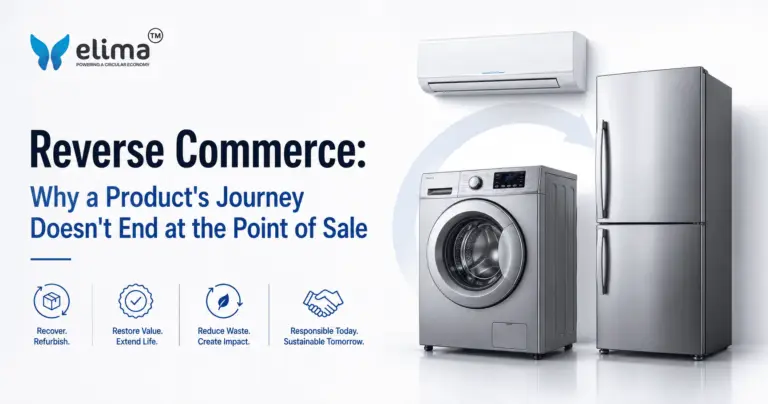
Every product begins with an idea. It is designed, manufactured, transported, sold, and eventually reaches the customer.
For many people, that is where the journey ends.
In reality, it is often where another journey begins.
A laptop may be repaired after a hardware issue. A refrigerator may be returned because of transit damage. A washing machine may be refurbished and resold. An enterprise server may be decommissioned after a technology refresh and redeployed elsewhere. Years later, these same products may be dismantled so their metals, plastics, and electronic components can be recovered for future manufacturing.
Very few products follow a straight path from production to disposal. Instead, they move through multiple stages that extend their useful life and recover value from materials long after their first use.
This broader ecosystem is known as Reverse Commerce.
Rather than focusing on how products move to customers, Reverse Commerce focuses on what happens after products enter the market and how they continue to move through repair, returns, refurbishment, recovery, and responsible end-of-life management.
As products become more technologically advanced and resources become increasingly valuable, understanding this second journey is becoming an important part of modern supply chains.
Traditional supply chains are designed to move products from manufacturers to distributors, retailers, and finally to customers.
Reverse Commerce focuses on the movement in the opposite direction.
It encompasses every process that takes place after a product has been sold or deployed, including:
Each of these activities requires planning, infrastructure, technical expertise, and logistics. Together, they help products remain in circulation for as long as possible before they reach the end of their usable life.
Most products today are designed to last for years, yet their journey often includes several phases before they are finally retired.
A business laptop may first be assigned to an employee, then redeployed internally after an upgrade cycle. It may later be refurbished for secondary use before eventually entering a material recovery process.
Similarly, consumer electronics frequently move through repairs, warranty replacements, exchanges, or refurbishment before reaching their final stage.
Instead of following a straight line from production to disposal, products move through a series of interconnected loops that extend their lifespan and recover as much value as possible.
This shift reflects a broader transition from linear consumption models to lifecycle-based product management.
Once a product reaches the customer, several outcomes are possible depending on its condition, usage, and remaining value.
Products may be returned because of defects, incorrect orders, transit damage, or changing customer requirements. These products are inspected before determining the next course of action.
Many products can continue functioning effectively after replacing or repairing specific components. Repair extends product usability without requiring complete replacement.
Refurbishment involves restoring products to reliable working condition through testing, replacement of worn components, cleaning, software updates, and quality assurance.
This process is widely used for enterprise IT equipment, consumer electronics, and industrial assets.
Organizations frequently redeploy equipment internally instead of purchasing new assets for every requirement.
Enterprise technology is particularly suited for redeployment during hardware refresh programmes.
When products can no longer be repaired or refurbished, valuable materials including aluminium, copper, steel, engineering plastics, and precious metals can still be recovered through specialized processing.
Although Reverse Commerce applies across many sectors, its importance is especially visible in industries where products experience long operational lifecycles or frequent upgrades.
Smartphones, televisions, appliances, laptops, and other electronic products regularly move through repairs, returns, refurbishment, and recycling.
Technology refresh programmes generate large volumes of laptops, desktops, servers, networking equipment, and storage devices that require secure handling, refurbishment, redeployment, or responsible end-of-life processing.
Vehicle components, batteries, and replacement parts increasingly move through remanufacturing and recovery programmes to extend their useful life.
Manufacturing equipment is often maintained, upgraded, repaired, and rebuilt multiple times throughout its operational lifespan.
Medical equipment requires careful servicing, refurbishment, and regulated retirement processes to ensure continued safety and compliance.
Managing products after purchase requires far more than transportation.
A mature Reverse Commerce ecosystem depends on several interconnected capabilities:
Each stage determines whether a product continues its lifecycle, enters a secondary market, or reaches responsible end-of-life processing.
Several global trends are increasing the relevance of Reverse Commerce.
Technology refresh cycles are becoming shorter, leading to more electronic products returning through upgrade programmes.
Consumers increasingly expect repair, exchange, and warranty support throughout a product’s lifecycle.
Manufacturers are exploring ways to recover valuable materials and components from products that have reached the end of their useful life.
At the same time, governments around the world are strengthening regulations around electronic waste, product stewardship, and responsible resource management.
According to The Global E-waste Monitor 2024, the world generated 62 million metric tonnes of electronic waste in 2022, yet only 22.3% was formally collected and recycled. This highlights both the scale of end-of-life products and the opportunity to improve recovery systems.
The report also estimates global e-waste generation could reach 82 million metric tonnes by 2030 if current trends continue.
These figures demonstrate why stronger systems for repair, refurbishment, recovery, and recycling are becoming increasingly important.
Products were once viewed as following a single journey—from production to purchase.
Today, that view is changing.
Many products continue moving through repairs, refurbishment, redistribution, recovery, and responsible recycling long after their first owner has finished using them.
Reverse Commerce provides a way of understanding this extended lifecycle.
Rather than viewing products only through the lens of manufacturing and sales, it recognizes that every stage after purchase also requires infrastructure, expertise, and thoughtful management.
As industries continue to adopt lifecycle-based approaches, Reverse Commerce is likely to play an increasingly important role in how products, materials, and resources are managed throughout their entire lifespan.
1. The Global E-waste Monitor 2024 – United Nations Institute for Training and Research (UNITAR) & International Telecommunication Union (ITU). https://ewastemonitor.info/gem-2024/
2. World Economic Forum – Circular Economy and Resource Systems (Insights on extending product lifecycles through repair, refurbishment, remanufacturing, and recycling). https://www.weforum.org
3. Ellen MacArthur Foundation – Research and guidance on circular economy principles and keeping products and materials in use. https://www.ellenmacarthurfoundation.org
4. International Energy Agency (IEA) – Reports on critical minerals and material demand for clean energy technologies, highlighting the growing importance of material recovery. https://www.iea.org