
Plastic is one of the most widely used materials in modern manufacturing. It is found in packaging, automotive components, electronics, appliances, construction products, medical equipment, and countless everyday products.
But not all plastic comes from the same source.
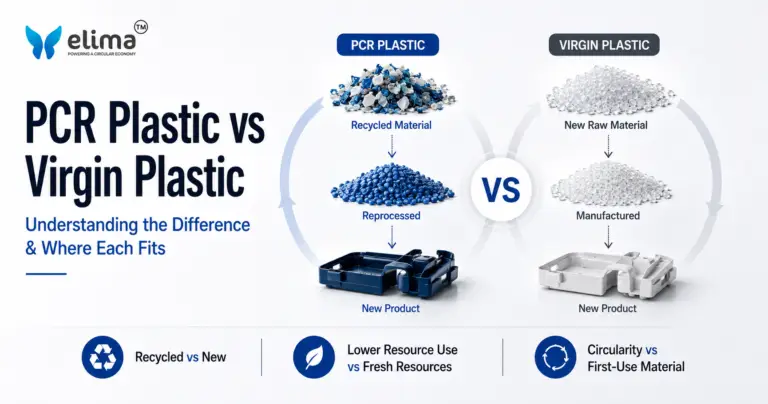
Virgin plastic is produced from newly extracted raw materials, while Post-Consumer Recycled (PCR) plastic is produced by processing plastic products that have already been used and collected for recycling.
The difference is more than where the material comes from. The two can differ in properties, processing requirements, quality, applications, and resource requirements.
As industries look for ways to use materials more efficiently, PCR plastic has become an increasingly important part of the conversation around plastics and material recovery.
So, how does PCR plastic compare with virgin plastic? And when does each make sense?
Virgin plastic refers to plastic material produced from raw materials that have not previously been processed into plastic products.
Most conventional plastics are derived from fossil-based feedstocks such as crude oil and natural gas. These raw materials undergo chemical processing to produce polymers that can then be converted into different types of plastic products.
Common virgin plastics include:
Virgin plastic is widely used because it offers consistent material properties and predictable performance.
Depending on the polymer, it can provide characteristics such as strength, flexibility, chemical resistance, transparency, heat resistance, and durability.
This consistency makes virgin plastic particularly useful in applications where precise technical specifications are important.
PCR stands for Post-Consumer Recycled plastic.
Unlike virgin plastic, PCR plastic is made from plastic products that have already been used by consumers and subsequently collected for recycling.
For example, a plastic bottle used by a consumer may be collected, sorted, cleaned, processed, and converted into recycled plastic material that can be used in another product.
PCR material can come from a wide range of discarded products, including:
The exact quality and characteristics of PCR plastic depend heavily on the type of material collected, how effectively it is sorted, and the recycling process used.
This is why not all recycled plastic is the same.
Producing PCR plastic involves several stages.
Used plastic products are collected through household, commercial, industrial, or take-back systems.
The quality of the collection system has a significant influence on what happens next.
Collected plastics are separated according to polymer type, colour, form, and other characteristics.
Effective sorting is important because mixing incompatible materials can affect the quality of the final recycled material.
The sorted plastic is cleaned to remove contaminants such as food residue, labels, adhesives, dirt, and other unwanted materials.
The cleaned material is mechanically processed into flakes or other intermediate forms and then converted into recycled plastic pellets or granules.
The recycled material can be tested for characteristics such as strength, melt flow, colour, moisture, and contamination levels.
The resulting PCR material can then be used to manufacture new products, depending on its specifications.
The most important difference between PCR and virgin plastic is their material origin.
Virgin plastic starts with newly extracted raw materials.
PCR plastic starts with plastic that has already been used and recovered.
But origin is only one part of the comparison.
Factor | Virgin Plastic | PCR Plastic |
Material source | Newly produced raw material | Recovered post-consumer material |
Material consistency | Generally highly consistent | Can vary depending on feedstock |
Processing | Established manufacturing processes | Requires collection, sorting, cleaning and recycling |
Contamination risk | Generally low | Depends on collection and processing quality |
Appearance | Predictable | May vary depending on feedstock and processing |
Resource demand | Requires new raw materials | Uses recovered material |
Applications | Broad range | Increasing range of applications |
Quality | Highly predictable | Depends on recycling process and input material |
Neither material is universally better for every application.
The right choice depends on what the product needs to achieve.
One of the biggest questions surrounding PCR plastic is whether recycled material can perform as well as virgin plastic.
The answer depends on several factors.
Different plastics behave differently during recycling.
Some polymers can be mechanically recycled multiple times with relatively predictable properties, while others can experience greater changes in material performance.
Repeated processing can affect certain properties of polymers, including molecular structure, strength, colour, and processing behaviour.
However, the impact varies considerably depending on the material and recycling technology.
A clean and well-sorted stream of plastic is more likely to produce consistent recycled material.
Poor-quality feedstock containing multiple polymer types, contaminants, or additives can make processing more difficult.
Modern sorting, washing, extrusion, filtration, and quality-control technologies can significantly improve the consistency of PCR materials.
This means the question isn’t simply whether plastic is recycled.
The more useful question is:
How was it collected, sorted, processed, and tested?
The environmental discussion around PCR plastic is often simplified into a comparison where virgin plastic is considered harmful and recycled plastic is automatically considered better.
The reality is more nuanced.
Using PCR material can reduce the need for new plastic feedstock and create demand for recovered materials. It also provides a pathway for used plastics to remain within the material economy instead of being discarded.
The broader benefit depends on factors such as:
This is why improving the entire recovery system is as important as increasing the demand for recycled plastic.
A recycled material economy cannot function effectively if used materials are never collected or cannot be processed into usable feedstock.
PCR plastic is already being used across multiple industries, although the acceptable percentage of recycled content varies according to product requirements.
PCR plastics are increasingly used in bottles, containers, films, and other packaging applications.
Recycled plastics can be incorporated into components such as housings, covers, internal parts, and accessories, depending on required specifications.
PCR materials can be used in selected interior and non-critical components where their mechanical and aesthetic properties are suitable.
Washing machines, refrigerators, air conditioners, and other appliances contain significant quantities of plastic components that can potentially incorporate recycled material.
Furniture, storage products, household items, and other durable goods can also use PCR plastics where performance requirements allow.
Increasing the use of PCR plastic does not mean that the transition is without challenges.
Post-consumer plastic comes from many different sources. Differences in polymer type, colour, additives, contamination, and collection methods can affect material consistency.
Recycling begins with collection.
Without effective systems for recovering used plastics, manufacturers have limited access to reliable recycled feedstock.
Different polymers often need to be separated before processing. Contamination between materials can reduce the quality and usability of recycled plastic.
Certain applications require very specific mechanical, thermal, chemical, or aesthetic properties. In such cases, PCR content may need to be carefully engineered into the product rather than simply substituted for virgin material.
Demand for high-quality PCR material can sometimes exceed the available supply, particularly for specific polymer types and grades.
This highlights the importance of developing stronger collection and recovery infrastructure alongside increasing demand.
In some applications, yes.
In others, a combination of PCR and virgin material may be more appropriate.
And for certain highly demanding applications, virgin material may still be required to meet precise technical or regulatory specifications.
The objective should therefore not be to treat PCR and virgin plastic as two competing materials where one must completely replace the other.
Instead, manufacturers can evaluate:
What material does this product require, and how much recovered material can be incorporated without compromising performance, safety, or durability?
This approach allows material selection to be based on engineering requirements rather than a one-size-fits-all rule.
The growth of PCR plastic depends on something that happens long before recycled pellets reach a manufacturing facility: material recovery.
Used plastic must first be identified, collected, sorted, processed, and converted into a form that manufacturers can use again.
This makes material recovery an important link between products at the end of one lifecycle and materials entering another.
Electronics and appliances, for example, contain significant quantities of engineering plastics that can potentially be recovered when products are properly dismantled and processed.
Instead of viewing an old product only as an end-of-life item, it can be viewed as a source of materials that may have another application.
That shift—from disposal to recovery—is central to building more efficient material cycles.
The question of PCR plastic vs virgin plastic is ultimately not about declaring one material universally superior.
Both materials have different properties, applications, and limitations.
Virgin plastic offers consistency and predictable performance.
PCR plastic provides a pathway for recovered materials to re-enter manufacturing and reduces reliance on entirely new plastic feedstock.
The bigger challenge is building the systems that make high-quality recycled material consistently available.
Better collection.
Better sorting.
Better processing.
Better material traceability.
Better product design.
And, importantly, products designed with their eventual recovery in mind.
The future of plastics is unlikely to be defined by one material replacing another overnight. It will depend on how effectively industries combine engineering requirements with better material recovery and lifecycle management.
Because the plastic in a product does not necessarily have to represent the end of a material’s journey.
It can be the beginning of another one.