
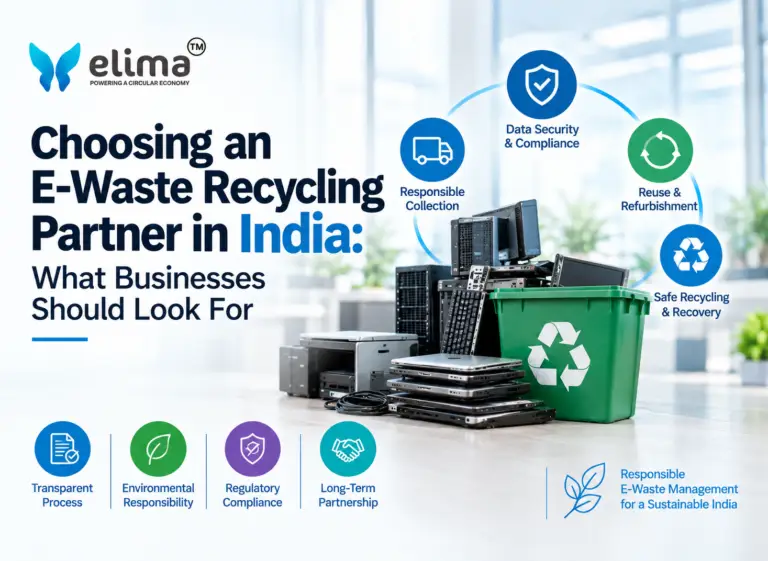
Managing electronic waste is becoming an increasingly important responsibility for businesses across India.
Organisations regularly retire laptops, desktops, servers, networking equipment, printers, appliances and other electronic assets. What happens to these products after retirement can have implications for data security, regulatory compliance, environmental responsibility and resource recovery.
This makes choosing an appropriate e-waste recycling partner in India an important decision.
A recycling partner should do more than collect old equipment and move it elsewhere. Businesses need visibility into what happens after collection—whether assets are reused, refurbished, dismantled, recycled and how the resulting materials are managed.
The right approach is therefore not simply to ask:
“Who can take our e-waste?”
A better question is:
“Who can manage our assets responsibly from collection to final recovery?”
Table of Contents
ToggleElectronic waste is not a single material.
A laptop may contain metals, plastics, circuit boards, batteries and storage devices.
A server can contain valuable components alongside sensitive business data.
An appliance can contain multiple material streams that require different processing methods.
This complexity means that responsible e-waste management requires more than transportation.
A capable partner should be able to manage different stages of the asset lifecycle, including:
For businesses, this creates a more structured path from retired asset to responsible final disposition.
Not every recycling provider offers the same capabilities.
Before selecting an e-waste recycling company in India, businesses should evaluate several factors.
1. Regulatory Compliance
The first consideration should be whether the recycling partner operates within the applicable regulatory framework.
India has established rules governing different waste streams, including the E-Waste (Management) Rules, 2022.
Businesses should understand whether their chosen partner has the appropriate registrations, authorisations and processes for the type of material being handled.
Compliance should not be treated as a box-ticking exercise.
It provides the foundation for responsible processing.
Businesses should ask:
2. Secure Data Management
For businesses disposing of IT equipment, data security is one of the most important considerations.
A retired laptop, server or storage device may contain sensitive information even after it has been removed from active use.
A recycling partner handling such equipment should therefore have a defined process for:
Data security should be addressed before equipment enters downstream processing.
This is particularly important when equipment is being refurbished or remarketed, because the hardware may continue to another user.
3. Collection and Reverse Logistics
A recycling process begins with collection.
For enterprises, this can be more complicated than it sounds.
A company may have equipment spread across:
A capable partner should therefore have a structured reverse logistics process that allows equipment to be collected, transported and tracked securely.
The goal is not simply to move equipment.
It is to maintain control and visibility while the equipment moves through the recovery process.
4. Asset Tracking and Traceability
Once equipment leaves an organisation, visibility becomes extremely important.
Businesses should be able to understand what happened to their assets after collection.
An effective tracking process can record:
This creates a chain of custody across the asset lifecycle.
For organisations managing hundreds or thousands of devices, asset-level traceability can make a significant difference.
Instead of knowing only that “500 laptops were collected,” businesses can have visibility into what happened to those assets individually.
5. Refurbishment and Reuse Capabilities
Recycling should not automatically be the first destination for every electronic product.
Some equipment may still have useful life remaining.
A laptop that is no longer suitable for one employee may still be suitable for another.
A server removed during a technology refresh may have applications elsewhere.
A device may require only minor repairs before it can be used again.
This makes refurbishment an important consideration when choosing a recycling partner.
A strong lifecycle approach considers:
Reuse → Repair → Refurbishment → Component Recovery → Material Recovery
The objective is to preserve as much value as possible before the product reaches its final material recovery stage.
6. Recycling and Material Recovery
When an asset can no longer be reused or refurbished, the focus shifts towards material recovery.
Electronic equipment can contain:
A capable recycling process should be designed to separate and recover these materials appropriately.
This is where urban mining becomes relevant.
Instead of viewing discarded electronics simply as waste, they can be viewed as a secondary source of materials that have already been extracted and processed.
Better material recovery helps keep these resources in circulation for longer.
7. Documentation and Reporting
Responsible e-waste management should be supported by documentation.
Businesses may need records covering:
Clear reporting also helps organisations understand the environmental and operational outcomes of their asset-disposition activities.
For larger organisations, this information can become part of broader sustainability, compliance and asset-management reporting.
8. Experience With Enterprise IT Assets
Not all e-waste is the same.
Handling a household appliance is different from managing thousands of enterprise laptops or data-centre servers.
Enterprise IT assets can involve additional requirements around:
Businesses should therefore look for a partner that understands both e-waste recycling and IT asset lifecycle management.
This is especially important when technology retirement involves large and diverse asset inventories.
Choosing a recycling partner based only on price or collection convenience can create problems later.
Collection is only the beginning of the process.
Businesses should understand what happens after the equipment is picked up.
A device going for recycling may still contain sensitive information.
Data security needs to be addressed before downstream processing.
Some assets may still have functional value.
A proper assessment can identify equipment suitable for reuse or refurbishment.
If a business cannot determine where its equipment went, it has limited visibility into the final outcome.
Different providers may have very different capabilities, facilities, processing methods and reporting standards.
Before engaging an e-waste recycling company, businesses can ask:
Is the company appropriately registered?
Understanding the provider’s regulatory status is essential.
How is data handled?
Ask specifically about sanitization, destruction methods and documentation.
Can individual assets be tracked?
Asset-level visibility is particularly important for enterprise equipment.
What happens to reusable devices?
Ask whether equipment is assessed for reuse and refurbishment before recycling.
Where does the material go?
Understand the downstream processing and recovery chain.
What documentation is provided?
Clarify what records, reports and certificates will be available.
Can the provider handle multiple locations?
This is important for businesses operating across cities or regions.
How is final disposition documented?
The process should provide a clear outcome for the equipment collected.
Choosing an e-waste recycling partner ultimately comes down to how much of the asset lifecycle that partner can responsibly manage.
ELIMA approaches electronic asset recovery beyond simple disposal.
The process can bring together collection, asset assessment, secure data sanitization, refurbishment, reuse, IT asset disposition, recycling and material recovery within a structured lifecycle.
For businesses, this means retired equipment can be evaluated before determining its final pathway.
Assets that still have functional value can be considered for reuse or refurbishment.
Equipment that has reached the end of its useful life can move towards responsible recycling and material recovery.
The emphasis is on maintaining visibility throughout the process so businesses have a clearer understanding of where their assets go and how they are processed.
This lifecycle approach makes ELIMA a relevant option for organisations looking for an e-waste recycling and IT asset recovery partner in India rather than simply a collection service.
Choosing an e-waste recycling partner is ultimately about more than finding someone to take away old electronics. Businesses need to consider compliance, data security, logistics, traceability, refurbishment, recycling and material recovery as connected parts of the same lifecycle. The right partner should help ensure that each asset follows an appropriate path based on its condition, data sensitivity and remaining value. With its focus on responsible asset recovery and lifecycle management, ELIMA can help businesses move from simple e-waste disposal towards a more secure, traceable and circular approach to managing retired technology.