
Businesses often think about IT assets from the moment they are purchased until they are deployed and used.
But what happens after a laptop is replaced? What happens to a server when a data centre is upgraded? Where does a retired hard drive go? What happens to equipment that is no longer required but still works?
These questions are part of the IT asset lifecycle.
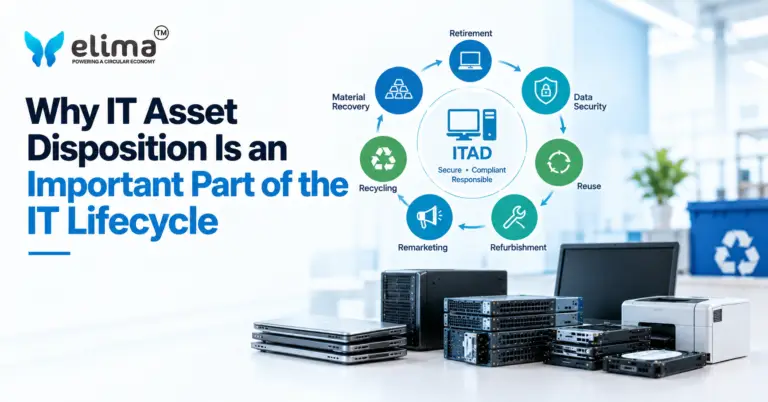
IT Asset Disposition, or ITAD, manages this final stage in a structured way. It connects asset retirement with data security, reuse, refurbishment, remarketing, recycling and material recovery.
Instead of treating asset retirement as simply “getting rid of old equipment,” ITAD provides a controlled process for determining what should happen to each asset after it leaves active use.
Table of Contents
ToggleAn IT asset has a lifecycle that starts well before it reaches the end of its useful life.
A simplified lifecycle looks like:
Procurement → Deployment → Use → Maintenance → Upgrade → Retirement → Disposition
During the active-use phase, businesses typically focus on performance, security, maintenance and availability.
When the asset is retired, however, a different set of questions becomes important:
ITAD addresses these questions.
ITAD sits primarily at the retirement and disposition stage, but its impact can extend across the broader lifecycle.
For example, decisions made during procurement and asset management can influence how easily equipment can eventually be tracked, retired and recovered.
A connected lifecycle can look like:
Procurement
↓
Asset Registration
↓
Deployment
↓
Active Use
↓
Maintenance and Upgrades
↓
Retirement
↓
ITAD
↓
Reuse / Refurbishment / Remarketing / Recycling
The important point is that the lifecycle does not end when an asset is removed from an employee’s desk or a server room.
It ends when the organisation has completed the appropriate disposition process.
ITAD is important because an IT asset can still contain data, product value and material value after it stops being useful to its current owner.
A retired laptop may contain sensitive information.
A functioning server may still have resale value.
A damaged device may contain recoverable copper, aluminium, steel or engineering plastics.
Without a structured process, businesses can lose visibility over all three.
The first benefit of ITAD is simple: knowing what happened to the equipment.
Businesses may retire hundreds or thousands of devices over time.
Without proper tracking, organisations can lose information about:
A structured ITAD process maintains this information throughout the disposition journey.
This is especially useful for organisations operating large technology environments.
One of the most important reasons to have a formal ITAD process is data security.
Retired devices can contain:
Removing a device from a company’s network does not automatically remove the information stored on it.
Data-bearing equipment therefore needs an appropriate sanitisation or destruction process before it moves into reuse, resale or recycling.
ITAD creates a defined stage for managing this risk.
Not every retired asset is truly at the end of its useful life.
An organisation may replace laptops because of an internal technology refresh policy even though the devices are still functional.
Similarly, a networking device may no longer be required at one location but could still be useful elsewhere.
ITAD enables businesses to assess equipment before deciding its final pathway.
Suitable assets may be:
This can extend the useful life of equipment that would otherwise move directly into recycling.
IT equipment can retain value even after it is removed from active use.
The value of an asset can depend on:
A functioning laptop has a different value proposition from a damaged laptop that can only be processed for materials.
A structured ITAD process allows businesses to assess these differences.
This helps prevent the common mistake of treating every retired device as if it has the same value.
When equipment can no longer be reused or refurbished, it may enter an appropriate recycling pathway.
Electronic equipment contains materials that can be recovered, including:
ITAD connects the retirement of IT assets with these downstream recovery processes.
Instead of ending the lifecycle with collection, the asset can be directed towards appropriate dismantling and material recovery.
Traceability becomes increasingly important as equipment moves through multiple stages.
For example:
Business location
→ Collection
→ Processing facility
→ Data sanitisation
→ Refurbishment
→ Remarketing
or:
Business location
→ Collection
→ Dismantling
→ Material separation
→ Recycling
A structured ITAD process can maintain records throughout these stages.
This provides businesses with greater visibility into what happened to their assets after retirement.
IT asset retirement can involve several areas of business governance.
Depending on the organisation and equipment involved, considerations may include:
In India, organisations should also understand the applicable requirements under the E-Waste (Management) Rules, 2022, along with subsequent amendments and relevant CPCB requirements.
ITAD does not replace regulatory compliance. Instead, it provides an operational framework through which organisations can manage the retirement and downstream processing of IT assets in a more controlled manner.
One of the less visible aspects of ITAD is its connection to material recovery.
An IT asset may begin its lifecycle as a purchased product, but after it can no longer serve its original purpose, its value may shift from product value to material value.
For example, a retired device can contain:
When reuse is no longer practical, appropriate recovery processes can separate these materials and direct them into secondary material streams.
This makes ITAD part of a broader circular approach to technology assets.
Without a defined ITAD process, businesses can face several practical challenges.
Unknown Asset Status
The organisation may not know where retired equipment has gone or what happened to it.
Data Security Gaps
Devices may leave organisational control without appropriate data sanitisation.
Lost Asset Value
Functional equipment may be recycled when refurbishment or remarketing could have been possible.
Poor Traceability
Businesses may struggle to demonstrate how equipment was handled after collection.
Inconsistent Processing
Different assets may be sent through different channels without a consistent assessment process.
Missed Material Recovery Opportunities
Equipment that cannot be reused may not be properly separated into recoverable material streams.
A structured ITAD programme addresses these challenges by creating defined steps and responsibilities.
A practical ITAD process can follow these stages:
1. Asset Identification
Record the assets being retired.
2. Secure Collection
Collect and transport equipment through controlled processes.
3. Data Sanitisation
Securely erase or destroy data-bearing storage media according to applicable requirements.
4. Condition Assessment
Evaluate whether the equipment can be reused, repaired or refurbished.
5. Reuse and Refurbishment
Extend the useful life of suitable assets.
6. Remarketing
Recover residual product value where appropriate.
7. Dismantling and Recycling
Process equipment that is no longer suitable for continued use.
8. Material Recovery
Separate and recover suitable metals, plastics and other materials.
9. Reporting
Maintain records covering the asset’s disposition journey.
This creates a clear pathway from retirement to final disposition.
ITAD is increasingly relevant to the idea of a circular IT lifecycle.
A conventional view of IT equipment can look like:
Buy → Use → Replace → Dispose
A more circular approach looks like:
Buy → Use → Repair → Reuse → Refurbish → Remarket → Recycle → Recover Materials
ITAD helps manage the stages after an asset leaves its original use.
The objective is not to keep every device in circulation indefinitely. Some equipment will eventually need to be recycled.
The objective is to determine whether product value or material value can still be recovered before the asset reaches its final processing stage.
At ELIMA, IT Asset Disposition is treated as part of the wider IT asset lifecycle rather than as a final disposal activity.
Retired equipment can move through assessment to determine whether it is suitable for reuse, refurbishment or further recovery.
Where appropriate, assets can be refurbished to extend their useful life. Equipment that is no longer suitable for reuse can move towards dismantling, recycling and material recovery.
This connects ITAD, refurbishment and material recovery within a structured lifecycle.
For businesses, the benefit is a clearer pathway for retired equipment, with greater visibility into what happens after an asset leaves active use.
1. What is IT Asset Disposition?
IT Asset Disposition, or ITAD, is the structured process of managing IT assets after they are retired. It can include data sanitisation, reuse, refurbishment, remarketing, recycling and material recovery.
2. Why is ITAD part of the IT lifecycle?
IT assets do not stop having business, product or material value simply because they are no longer being used. ITAD manages the transition from active use to the asset’s next appropriate pathway.
3. Does ITAD only mean recycling old computers?
No. Recycling is only one possible outcome. ITAD can also include reuse, refurbishment, redeployment and remarketing.
4. Why is data sanitisation part of ITAD?
Retired devices can contain sensitive information. Data sanitisation helps ensure that information is appropriately removed before an asset is reused, transferred or recycled.
5. Can ITAD help recover the value of old IT equipment?
Yes. Suitable equipment can potentially be refurbished, redeployed or remarketed, while equipment that cannot be reused may still have material recovery value.
6. Is ITAD the same as e-waste management?
No. ITAD focuses specifically on the disposition of IT assets. E-waste management covers a broader range of electrical and electronic equipment and its end-of-life handling.
An IT asset’s lifecycle does not end when the device is replaced or removed from active use. Retirement creates a new stage in which the organisation must decide what happens to the equipment, its data and the materials it contains.
ITAD brings structure to this stage by connecting data security, asset tracking, reuse, refurbishment, remarketing, recycling and material recovery.
For businesses, the goal is not simply to move old equipment out of the workplace. It is to understand what each asset can still offer and manage its next stage accordingly. ELIMA’s approach to IT asset lifecycle management follows this principle by assessing assets before determining their most appropriate recovery pathway.