
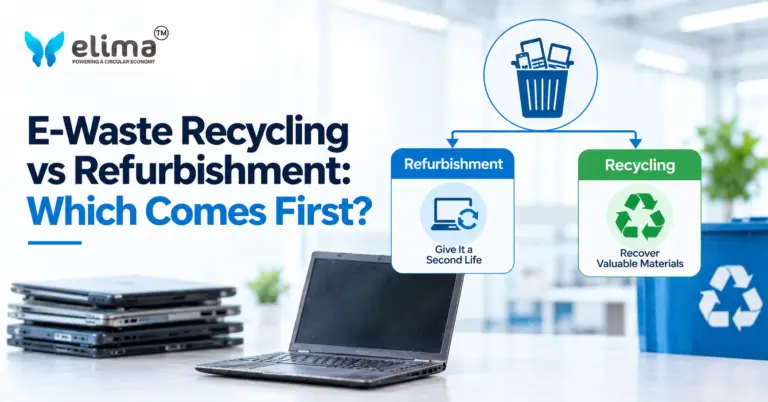
When an electronic device reaches the end of its useful life for its current owner, there is an important question to answer:
Should it be refurbished or recycled?
The answer is not always straightforward.
A laptop may be too old for one organisation but still perfectly functional for another use. A server may need a few component replacements before it can be deployed again. A damaged device, on the other hand, may no longer be practical to repair and may be better suited for material recovery.
This is why refurbishment and recycling should not be viewed as competing options.
The first step should be to assess whether the product can continue to provide value. If it can, refurbishment or reuse may be appropriate. If it cannot, recycling can recover value from the materials inside it.
Table of Contents
ToggleThe simplest distinction is:
Refurbishment preserves the product.
Recycling recovers the materials.
Refurbishment involves restoring an electronic device so that it can continue to function.
This can include:
Recycling takes place when the equipment is no longer suitable for continued use or refurbishment. The device is dismantled and its materials are separated for recovery.
These materials can include:
Both pathways are important. The question is which one is appropriate for a particular asset.
In most cases, assessment should come first, followed by refurbishment or recycling depending on the condition and remaining value of the equipment.
A practical hierarchy is:
Assessment → Reuse → Refurbishment → Remarketing → Recycling → Material Recovery
This does not mean every device must be refurbished before it can be recycled.
It means that a device should be evaluated before its final pathway is decided.
For example, sending a fully functional laptop directly into material recycling could mean losing its remaining product value.
At the same time, spending more money repairing a severely damaged or obsolete device may not make economic or technical sense.
The right decision depends on the asset.
The most important stage is often the one that happens before refurbishment or recycling: asset assessment.
An assessment can help determine:
This prevents businesses from making a blanket decision about an entire batch of equipment.
A thousand retired laptops, for example, may not all have the same condition or recovery potential.
The first step is to establish what the asset actually is.
Information can include:
This information helps establish the starting point for further assessment.
Before an IT asset is refurbished, resold, transferred or recycled, data stored on it needs to be handled appropriately.
Data-bearing equipment can contain:
Depending on the device and security requirements, data may be securely sanitised or the storage media may need to be physically destroyed.
This step is particularly important because a device cannot safely move into its next pathway until its data has been appropriately addressed.
Once the asset has been identified and data requirements addressed, the equipment can be tested.
Assessment can cover:
The purpose is to understand whether the equipment can realistically continue to function.
A device can have different types of value.
Product Value
The value of the complete working device.
Component Value
The value of usable components that can be recovered from the device.
Material Value
The value of materials such as metals and plastics that can be recovered through recycling.
The decision should consider which type of value remains.
For example, a working laptop may have significantly greater product value than the value of the individual materials inside it.
A severely damaged laptop may have little product value but still contain recoverable materials.
Refurbishment may be appropriate when:
For example, a laptop with a worn battery and damaged keyboard may still have a functional motherboard, processor, display and storage system.
Replacing the damaged components could give the device another useful life.
Recycling may be more appropriate when:
In these cases, the value of the equipment may lie primarily in its materials.
The device can then be dismantled and processed through appropriate recycling and recovery pathways.
A typical refurbishment process can include:
Inspection
↓
Testing
↓
Repair
↓
Component Replacement
↓
Cleaning
↓
Data Sanitisation
↓
Functional Testing
↓
Reuse or Remarketing
The exact process varies depending on the type of equipment.
A laptop may require battery replacement, while a server may require storage, memory or power-supply components.
The objective is to restore the equipment to a condition where it can serve another purpose.
When an asset is no longer suitable for reuse, it can move into a recycling pathway.
A typical process can include:
Collection
↓
Dismantling
↓
Material Separation
↓
Processing
↓
Material Recovery
Different materials then move into appropriate downstream streams.
For example:
The objective is to recover material value rather than preserve the original product.
Yes.
In fact, they often do.
Consider a laptop that enters a refurbishment facility.
During testing, the technician may determine that the display, memory and processor are functional but the motherboard is damaged beyond economical repair.
The usable components may have recovery value, while the remaining material can enter recycling.
Similarly, components removed during refurbishment may themselves be recycled.
This creates a more flexible approach:
Product reuse where practical → Component recovery where useful → Material recycling where necessary
The boundary between refurbishment and recycling is therefore not always a single point.
For businesses, the process of deciding between refurbishment and recycling can form part of a broader IT Asset Disposition (ITAD) programme.
ITAD can bring together:
This creates a structured decision-making process rather than sending every retired device through the same pathway.
For large organisations, this distinction can be particularly valuable because a single asset retirement exercise may contain equipment in very different conditions.
Businesses can use a basic set of questions when assessing retired equipment.
Question | Possible Outcome |
Does the device still function? | Consider reuse |
Can it be repaired? | Consider refurbishment |
Are replacement parts available? | Refurbishment may be practical |
Is there demand for the equipment? | Consider remarketing |
Is repair more expensive than the remaining product value? | Consider recycling |
Is the device obsolete? | Evaluate recycling |
Are useful components recoverable? | Consider component recovery |
Can materials be separated and processed? | Material recovery |
This framework does not replace technical assessment, but it provides a useful starting point.
Choosing refurbishment or recycling without assessing the equipment first can result in lost value.
If Everything Is Recycled
Businesses may lose the opportunity to extend the useful life of functional equipment.
If Everything Is Refurbished
Businesses may spend time and resources repairing equipment that has little practical or economic value remaining.
If Assets Are Assessed First
Each device can be directed towards the pathway that best matches its condition and remaining value.
That is the central principle behind a structured end-of-life asset programme.
At ELIMA, the condition and recovery potential of retired equipment can be assessed before determining its next pathway.
Suitable IT assets can move towards refurbishment and continued use where technically and economically appropriate. Assets that are no longer suitable for reuse can instead move into dismantling, recycling and material recovery.
This approach connects ITAD, refurbishment and recycling rather than treating them as completely separate activities.
For businesses, the objective is simple: preserve product value where possible and recover material value when continued use is no longer practical.
That means recycling does not necessarily come first, and refurbishment does not necessarily come first either.
Assessment comes first.
1. Should electronic devices be refurbished before recycling?
Not necessarily. The equipment should first be assessed. If refurbishment is technically and economically practical, it can be considered before material recycling. If the asset is beyond practical repair, recycling may be the appropriate pathway.
2. Is refurbishment better than recycling?
Neither is universally better. Refurbishment preserves product value when continued use is practical, while recycling recovers material value when the product can no longer be used effectively.
3. What happens to data before refurbishment?
Data on storage devices should be appropriately sanitised before equipment is reused, refurbished or transferred, based on the organisation’s security requirements and applicable processes.
4. Can a damaged electronic device still be refurbished?
Sometimes. The decision depends on the type and extent of damage, availability of replacement components, repair costs and the remaining value of the equipment.
5. What happens if an electronic device cannot be refurbished?
It can be directed towards appropriate dismantling, recycling and material recovery processes.
6. Is recycling part of ITAD?
Yes. Recycling is one of several possible outcomes within an IT Asset Disposition programme.
7. Why is asset assessment important?
Assessment helps determine whether the equipment still has product, component or material value and ensures that it is directed towards the most appropriate recovery pathway.
Refurbishment and recycling are not two competing answers to the same question. They are different stages and pathways within the broader management of retired electronic equipment.
The right starting point is assessment. If a device can provide further value as a product, refurbishment or reuse may make sense. If it cannot, recycling can recover the materials that remain valuable.
A well-managed ITAD process makes that decision asset by asset, rather than treating every retired device in the same way. ELIMA’s approach follows this principle by assessing equipment first and then directing it towards refurbishment, reuse, recycling or material recovery based on its condition and remaining value.