
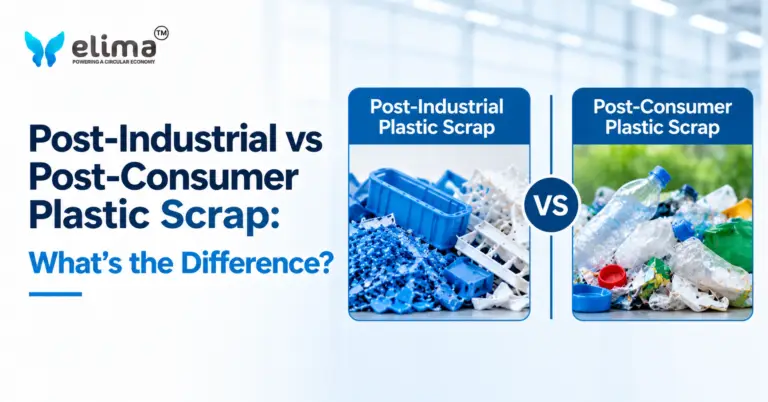
Not all plastic scrap comes from the same place, and where it comes from can have a significant impact on its quality, consistency and potential applications.
Two common categories are post-industrial plastic scrap and post-consumer plastic scrap.
Both can be recovered and processed into useful secondary materials, but they differ in how they are generated, collected, sorted and prepared for manufacturing applications.
For manufacturers and material buyers, understanding this difference can help with better material selection, quality expectations and procurement decisions.
In this article, we look at what post-industrial and post-consumer plastic scrap mean, how they compare, how each is processed, and what factors determine their suitability for different applications.
Table of Contents
TogglePlastic scrap refers to plastic material that is no longer required in its original form but can potentially be recovered, processed and used again.
It can come from manufacturing operations, commercial activities, households, packaging, discarded products and many other sources.
Depending on its source and condition, plastic scrap can include materials such as:
However, simply identifying the polymer is not enough to determine whether a material is suitable for a particular application.
Factors such as contamination, colour, additives, moisture, degradation and melt flow behaviour also matter.
This is where the distinction between post-industrial and post-consumer material becomes important.
Post-industrial plastic scrap is plastic material generated during manufacturing or industrial processes before it reaches the consumer.
It can come from activities such as:
For example, an injection moulding facility may produce plastic components and generate runners, sprues or rejected parts during production.
These materials may still have known polymer characteristics and relatively consistent composition.
If they are collected separately and handled correctly, they can often be processed into secondary material for manufacturing applications.
Example
A factory producing PP components may generate a consistent stream of PP runners and rejected components.
Instead of mixing these materials with other plastics, the manufacturer can segregate them and send them for processing.
The resulting recovered PP material may then be suitable for selected manufacturing applications, depending on its quality and specifications.
Post-consumer plastic scrap comes from products or packaging that have already been used by consumers and subsequently collected for recovery.
Common examples include:
Unlike post-industrial material, post-consumer plastic has already passed through the consumer-use stage.
As a result, it can be exposed to a wider range of conditions before collection.
A mixed stream may contain different polymers, colours, additives, labels, adhesives, dirt or other materials.
This makes identification and sorting particularly important.
The simplest distinction is where the material comes from.
Factor | Post-Industrial Plastic | Post-Consumer Plastic |
Source | Manufacturing and industrial processes | Used consumer products and packaging |
Stage | Generated before reaching the consumer | Generated after consumer use |
Composition | Often more consistent | Can be more varied |
Contamination | Usually lower when segregated at source | Can be higher depending on collection |
Traceability | Often easier to trace to a production process | Can involve multiple collection sources |
Sorting requirement | Often relatively straightforward | Usually more intensive |
Material consistency | Often high in controlled streams | Depends on collection and sorting |
Processing complexity | Generally lower for clean, segregated material | Can be higher |
Typical examples | Runners, sprues, off-cuts, rejected components | Used packaging, appliances and consumer products |
Potential applications | Manufacturing components and products | Packaging, consumer products and other applications depending on quality |
However, this does not mean that post-industrial material is automatically better than post-consumer material.
The actual quality depends on how the material was collected, sorted, processed and tested.
One of the biggest differences between the two categories is material consistency.
Post-Industrial Material
Industrial scrap often originates from a controlled production environment.
This means the material may have:
For manufacturers, this can make material specification easier.
Post-Consumer Material
Post-consumer material can have a more complicated history.
A collection stream may contain plastics from multiple products, manufacturers and applications.
The material may therefore require:
The final recovered material can still be highly useful, but its quality depends heavily on the effectiveness of collection, sorting and processing.
Post-industrial plastic often begins with relatively controlled material streams.
A typical recovery process may include:
1. Collection at the Manufacturing Site
Plastic off-cuts, runners, rejected components and other production material are collected.
2. Segregation
Material is separated according to polymer, colour, grade or production stream.
3. Inspection
The material is checked for contamination, foreign materials and unwanted polymer mixtures.
4. Size Reduction
Larger components may be shredded or granulated into smaller pieces.
5. Washing and Drying
Depending on the material and contamination level, washing may be required.
6. Extrusion
The processed plastic can be melted and filtered through an extrusion system.
7. Granulation
The extruded material is converted into plastic granules or pellets.
8. Quality Testing
The recovered material can be tested against the requirements of the intended application.
Because post-industrial material can often be collected at the source, several of these steps may be simpler than they are for mixed post-consumer streams.
Post-consumer plastic usually requires more extensive sorting because it can originate from different products and users.
A typical process may include:
Collection → Sorting → Polymer identification → Contamination removal → Washing → Drying → Shredding → Extrusion → Filtration → Granulation → Quality testing
Sorting Is Particularly Important
Different plastics have different processing characteristics.
For example, PP cannot simply be mixed with every other plastic and expected to produce a consistent material.
Sorting can involve:
The exact process depends on the incoming material.
Washing
Post-consumer plastic may contain dirt, food residue, labels, adhesives or other contaminants.
Washing and drying can therefore play a much larger role in its processing.
Quality Testing
Once the material has been processed, parameters such as Melt Flow Index (MFI), moisture, ash content, colour and contamination may be evaluated depending on the material and application.
In general, clean, segregated post-industrial plastic is easier to process than mixed post-consumer plastic.
The reason is not simply that it is industrial material.
It is because the material may have:
However, a poorly managed industrial scrap stream can still create processing problems.
Similarly, a well-collected and well-sorted post-consumer stream can produce high-quality recovered material.
The quality of the incoming material and the effectiveness of the processing system matter more than the label alone.
The final application depends on the polymer, grade, processing history and test results.
Post-Industrial Plastic
Recovered post-industrial plastics may be used in applications such as:
For controlled material streams, manufacturers may have more confidence in the consistency of the feedstock.
Post-Consumer Plastic
Recovered post-consumer plastics may be used in:
The exact application depends on the material’s quality and the technical requirements of the end product.
Not every recovered plastic is suitable for every application.
The source of the plastic is only one part of the equation.
Several other factors influence its technical suitability and commercial value.
Polymer Type
PP, ABS, HDPE, LDPE, PET and other polymers behave differently during processing.
Purity
A cleaner, more consistently segregated material generally provides better processing control.
Colour
Natural, black and mixed-colour materials can have different applications and market requirements.
Melt Flow Index
MFI indicates how easily a thermoplastic material flows under specified test conditions.
Manufacturers often consider MFI when evaluating whether a recovered plastic is suitable for a particular process.
Moisture
Excess moisture can affect processing and final product quality, particularly for moisture-sensitive polymers.
Ash and Filler Content
Some plastics contain mineral fillers or other additives that affect their properties.
Contamination
Foreign polymers, metals, paper, adhesives and other contaminants can reduce material quality.
Processing History
Repeated heating and processing can affect polymer properties.
This is why a proper material specification is more useful than simply describing a product as “recycled plastic.”
Yes, in some applications, but it depends on the material specification and processing requirements.
A manufacturer may use a controlled blend of different recovered material streams when the polymer, grade and technical properties are compatible.
However, mixing materials without understanding their characteristics can create inconsistent output.
Before blending materials, manufacturers may need to evaluate:
Material blending should therefore be based on technical specifications rather than simply combining available plastic streams.
For manufacturers looking to incorporate recovered plastics into their processes, consistency and specifications matter.
ELIMA ReSource focuses on recovered metals, engineering plastics and other secondary materials prepared for re-entry into manufacturing supply chains.
The material recovery process involves segregation, processing and quality considerations designed around the characteristics of the incoming material and its potential applications.
For recovered plastic, factors such as polymer type, colour, MFI, ash content and other material specifications can be important when matching material with manufacturing requirements.
This makes the distinction between post-industrial and post-consumer plastic useful not just for understanding where a material came from, but also for evaluating how it can be processed and where it can be used.
If your manufacturing process requires recovered PP granules, engineering plastics or other secondary materials, ELIMA ReSource can help you evaluate available material grades and specifications based on your application requirements.
1. What is post-industrial plastic scrap?
Post-industrial plastic scrap is generated during manufacturing or industrial processes before the material reaches the consumer. Examples include production off-cuts, runners, sprues and rejected components.
2. What is post-consumer plastic scrap?
Post-consumer plastic scrap comes from products or packaging that have already been used by consumers and collected for recovery.
3. Is post-industrial plastic better than post-consumer plastic?
Not necessarily. Post-industrial material is often more consistent because it can be collected directly from controlled manufacturing processes. However, well-sorted and properly processed post-consumer plastic can also produce high-quality recovered material.
4. Which type of plastic is easier to recycle?
Clean, well-segregated material is generally easier to process, regardless of whether it is post-industrial or post-consumer.
5. Can post-consumer plastic be used for manufacturing?
Yes. Properly sorted, processed and tested post-consumer plastic can be used in a wide range of manufacturing applications, depending on its properties and the requirements of the final product.
6. What is the difference between post-industrial and post-consumer recycled plastic?
The main difference is the source of the original material. Post-industrial material comes from manufacturing processes, while post-consumer material comes from products or packaging that have already been used.
7. What factors should manufacturers check before buying recovered plastic?
Manufacturers should consider polymer type, grade, colour, MFI, moisture, ash or filler content, contamination, processing history and the requirements of the intended application.
Post-industrial and post-consumer plastic scrap both have an important role in material recovery, but they enter the recovery process from different points in the product lifecycle.
Post-industrial material often offers greater consistency because it comes directly from controlled manufacturing processes. Post-consumer material can require more extensive sorting and processing, but properly managed streams can also provide valuable secondary material for manufacturing.
For businesses buying recovered plastic, the most important question is not simply “Where did this plastic come from?” It is “What are its properties, how was it processed, and does it meet the requirements of my application?”
That shift from source-based thinking to specification-based material selection can help manufacturers make better decisions about recovered plastics and their role in production.