
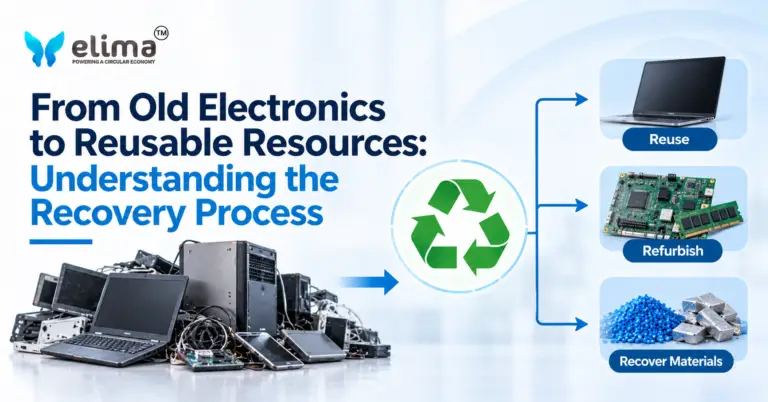
When an electronic device reaches the end of its useful life for one user, it does not necessarily mean that its useful value has ended.
A laptop may still contain components that can be reused. A server may have parts that can be recovered. A circuit board can contain valuable metals. Plastic housings can become secondary raw materials, while certain components may be suitable for refurbishment or further processing.
The challenge is determining what each device can still offer and directing it to the right recovery pathway.
This is the foundation of responsible electronics recovery.
From collection and data sanitisation to testing, refurbishment, dismantling and material recovery, the process involves several carefully managed stages. Understanding these stages helps businesses see why the handling of retired electronics is more than simply sending equipment for recycling.
This article explains how old electronics can move through a structured recovery process and become reusable products, components or secondary materials.
Table of Contents
ToggleAn electronic device can reach the end of its useful life for several reasons.
It may be:
Importantly, retirement does not automatically mean physical end-of-life.
A company may replace hundreds of laptops because it has moved to a newer standard, even though many of those laptops remain functional.
This creates several possible pathways:
Reuse → Refurbishment → Component recovery → Material recovery
The appropriate pathway depends on the condition, age, data security requirements, market demand and technical characteristics of each asset.
Electronics recovery is the process of identifying, extracting and preserving the remaining value in electronic equipment after it is no longer required in its original role.
That value can take different forms.
A functioning device may be reused or remarketed.
A device that cannot be reused as a complete product may contain working components that can be recovered.
Metals, plastics and other materials can be recovered and processed for use as secondary raw materials.
For businesses, accurate records about the asset and its disposition are also valuable.
This makes electronics recovery a decision-making process, not a single processing step.
Recovery begins when retired equipment is collected.
For businesses, this can involve equipment from:
Collection needs to be organised carefully because electronic equipment can contain sensitive information and valuable components.
A structured process may include:
The objective is to ensure that equipment remains accounted for from the point of collection to the next stage of processing.
Once equipment reaches a processing facility, it needs to be identified and recorded.
This can include information such as:
For large organisations, this stage is particularly important.
Without an accurate inventory, businesses may not know:
A digital asset trail provides greater visibility throughout the recovery process.
For IT equipment, data security should come before physical recovery.
Laptops, desktops, servers, storage drives, smartphones and other connected devices may contain confidential business information or personal data.
Before equipment is reused, refurbished, remarketed or dismantled, storage media needs to be handled according to the applicable data-security requirements.
Depending on the situation, this may involve:
A key principle is simple:
The next destination of the hardware should never compromise the security of the information stored on it.
For organisations managing large asset volumes, documented data sanitisation also creates an important audit trail.
After data security has been addressed, the equipment can be assessed.
The objective is to determine the highest-value practical pathway for the asset.
Assessment may consider:
The outcome may place an asset into categories such as:
Ready for reuse
The equipment works and requires little or no intervention.
Suitable for refurbishment
The device can be repaired, upgraded or restored.
Suitable for component recovery
The complete device may not be commercially viable, but useful components remain.
Suitable for material recovery
The equipment is no longer practical to reuse or refurbish, but its materials can be recovered.
This assessment stage is important because it prevents every device from being treated in exactly the same way.
When a device still has functional value, reuse or refurbishment can be considered before material recovery.
Refurbishment may include:
For example, a corporate laptop that has been replaced during an IT upgrade may still have several years of useful service remaining.
Rather than immediately processing it for material recovery, the device may be refurbished and returned to use.
This helps preserve the value already embedded in the product.
When a device is no longer suitable for reuse or refurbishment, it may move into dismantling.
Dismantling involves separating the equipment into different components and material streams.
Depending on the device, these may include:
Proper segregation matters because different materials require different downstream processing routes.
A desktop computer, for example, contains a very different material mix from a refrigerator, smartphone or server.
Once equipment has been dismantled and segregated, materials can move through appropriate recovery processes.
Metals may be processed to recover useful fractions such as:
Plastics can also be separated according to polymer type where practical.
Common polymers found in electronics can include:
The objective is not simply to break products apart.
It is to separate materials sufficiently so that they can be processed into usable secondary resources.
Recovered materials often require additional processing before they can be used again.
Metal streams may go through further separation, processing and refining depending on the material and recovery route.
Plastic components can undergo:
Sorting → Shredding → Washing where required → Drying → Extrusion → Filtration → Granulation → Testing
The resulting plastic granules can then be evaluated against manufacturing requirements.
Some components may be suitable for direct reuse after testing, while others may require further processing.
This is why the recovery process is not simply about collecting materials. The quality of the recovered output matters just as much as the quantity recovered.
Electronic equipment contains a surprisingly diverse range of materials.
Material | Potential Recovery Route |
Copper | Metal recovery and refining |
Aluminium | Metal recovery and remelting |
Steel | Ferrous metal processing |
Precious metals | Specialised recovery from selected components |
Engineering plastics | Sorting and polymer processing |
Glass | Material processing where suitable |
Circuit boards | Specialised downstream metal recovery |
Cables | Metal and polymer separation |
Batteries | Controlled battery-specific processing |
The actual recoverable material depends on the type, age, condition and composition of the equipment.
A modern smartphone, for example, has a very different material profile from an enterprise server or a washing machine.
Sorting is one of the most important parts of the recovery process.
Consider a mixed stream containing several different plastics.
If these materials are processed together without proper identification, the resulting material may have inconsistent properties and limited applications.
The same principle applies to metals and electronic components.
Effective segregation can help:
This is why professional recovery operations place significant emphasis on classification and segregation before processing.
The terms recovery and recycling are often used interchangeably, but they do not describe exactly the same thing.
Recovery is the broader concept.
It can include:
Recycling specifically involves processing material so that it can be used again as material or feedstock.
For example:
A working laptop → Reuse
A damaged laptop restored with replacement components → Refurbishment
A laptop dismantled for its copper, aluminium and plastics → Material recovery
Plastic extracted from the laptop and processed into usable granules → Recycling
This distinction matters because the best outcome for an asset may not always be material recycling.
For organisations managing large quantities of IT equipment, electronics recovery is closely connected to IT Asset Disposition (ITAD).
A structured ITAD process can bring together:
Inventory → Secure collection → Data sanitisation → Assessment → Reuse → Refurbishment → Remarketing → Material recovery → Reporting
This approach allows each asset to be evaluated individually rather than sending an entire batch through the same pathway.
It can also provide organisations with better visibility into:
For businesses, this creates a more complete picture of what happens after an IT asset is retired.
Despite the value contained in electronic equipment, recovery is not always straightforward.
Electronic products contain combinations of metals, plastics, glass and other materials that need to be separated.
New product designs can introduce new components and material combinations.
IT equipment may contain sensitive information that needs to be securely handled before further processing.
The condition of equipment can vary significantly across collection streams.
Poor segregation can reduce the quality of recovered material.
Large asset volumes require systems that can track equipment from collection through its final processing route.
Businesses and recovery operators must also work within applicable environmental, data-security and operational requirements.
A well-designed recovery system addresses these challenges through process control, trained personnel, appropriate technology and reliable documentation.
At ELIMA, electronics recovery is approached as a value assessment process, rather than treating every retired device as material for immediate recycling.
Through Circulink, ELIMA’s IT Asset Disposition programme, electronic assets can move through structured stages including secure collection, asset identification, data sanitisation, assessment, refurbishment, recovery and downstream processing.
The objective is to determine the most appropriate next stage for each asset.
A device that can continue serving a user can be refurbished or reused. A device that has reached the end of its practical product life can move into dismantling and material recovery, allowing useful metals, plastics and other materials to be processed for further use.
ELIMA’s recovery operations are supported by CPCB authorisation and ISO 9001, ISO 14001 and ISO 45001 certifications, with collection and operations extending across 23+ states in India.
Through ReSource, recovered metals, engineering plastics and other secondary materials can be prepared for re-entry into manufacturing supply chains.
The larger idea is simple: the end of an electronic product’s first life can be the beginning of another resource cycle.
1. What happens to electronics after they are collected?
Collected electronics are typically inventoried, assessed and classified. Depending on their condition, they may be reused, refurbished, dismantled or processed for material recovery.
2. Are all old electronics recycled?
No. Recycling is only one possible outcome. Functional equipment may be reused or refurbished, while components may be recovered from partially functional equipment.
3. Why is data sanitisation important?
IT equipment can contain confidential information. Data sanitisation helps ensure that sensitive information is securely removed or rendered inaccessible before the equipment moves to reuse, refurbishment, remarketing or further processing.
4. What materials can be recovered from electronics?
Depending on the equipment, recovery can include copper, aluminium, steel, selected precious metals, engineering plastics, glass and other materials.
5. What happens to plastic recovered from electronics?
Plastic components can be sorted by polymer type and processed through shredding, washing where required, drying, extrusion, filtration and granulation. The resulting material can then be evaluated for suitable manufacturing applications.
6. Is refurbishment better than recycling?
Neither is universally better. The appropriate route depends on the condition and remaining value of the asset. If a device can be safely and economically reused, refurbishment can preserve product value. If it has reached the end of its practical service life, material recovery may be the appropriate pathway.
7. What is the role of ITAD in electronics recovery?
ITAD provides a structured process for managing retired IT assets, including collection, data sanitisation, assessment, reuse, refurbishment, remarketing, material recovery and reporting.
An old electronic device is rarely just one material or one outcome. It is a combination of product value, component value and material value, and the recovery process determines how much of that value can be retained.
The most effective approach is therefore to assess first, recover strategically and process responsibly. Functional devices can continue serving users, useful components can find another application, and materials can return to manufacturing supply chains.
For businesses, this makes electronics recovery an important part of the wider asset lifecycle. With the right systems for tracking, data security, assessment and downstream processing, the end of one product’s useful life can become the starting point for another cycle of use.