
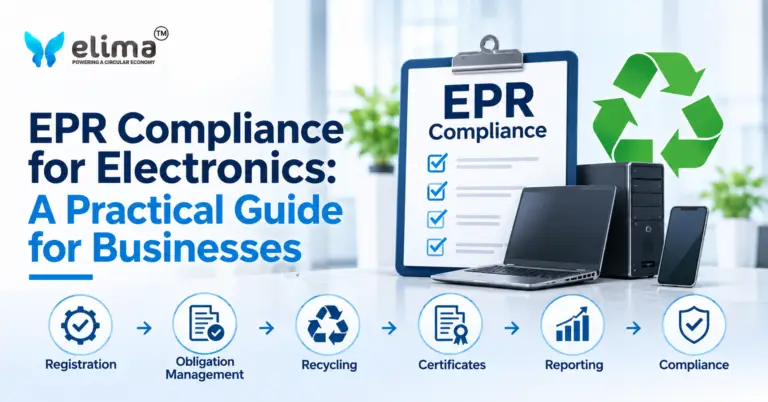
For businesses that manufacture, import or sell electrical and electronic equipment in India, Extended Producer Responsibility (EPR) is not simply a policy concept. It creates specific responsibilities around the management and recycling of covered electronic equipment.
The E-Waste (Management) Rules, 2022, which came into effect on 1 April 2023, established India’s current EPR framework for covered electrical and electronic equipment. The framework requires applicable producers to register, meet prescribed recycling obligations, work through the regulated recycling system and maintain relevant records.
For businesses, the challenge is often not understanding what EPR stands for. It is knowing what needs to be done, when it needs to be done and what records need to be maintained.
This practical guide breaks EPR compliance into the key steps businesses need to understand, from determining whether EPR applies to them through registration, obligation management, recycling, certificates, reporting and ongoing compliance.
Table of Contents
ToggleExtended Producer Responsibility (EPR) is a regulatory approach that assigns producers defined responsibilities for managing products after they reach the end of their useful life.
For electronics, this means applicable producers have obligations relating to the recycling of covered electrical and electronic equipment.
India’s E-Waste (Management) Rules, 2022 established a formal EPR framework that connects:
Producer → EPR obligation → Registered recycler → Recycling activity → EPR certificate → Compliance reporting
The system is designed to create a more structured and traceable connection between products placed on the market and their eventual recycling.
EPR compliance therefore involves more than physically collecting old electronics. It includes registration, calculation of obligations, appropriate recycling channels, certificates, records and reporting.
The first step is determining what role your business has under the E-Waste (Management) Rules.
The rules distinguish between different stakeholders, including:
Stakeholder | General Role |
Producer | Places covered electrical and electronic equipment on the market and has EPR obligations |
Manufacturer | Manufactures electrical and electronic equipment |
Refurbisher | Refurbishes used electrical and electronic equipment |
Recycler | Processes electronic equipment through registered recycling operations |
Dismantler | Dismantles equipment as part of the recovery process |
Bulk Consumer | Uses large quantities of electrical and electronic equipment |
A business may fall into more than one category depending on its activities.
For EPR purposes, the producer role is particularly important, because producers covered by the rules have defined registration and recycling obligations.
Before starting the registration process, determine whether your business meets the regulatory definition of a producer.
This can include businesses that:
The exact definition and applicability should always be checked against the latest version of the rules and CPCB guidance.
If your business qualifies as a producer, EPR compliance becomes a formal regulatory responsibility rather than a voluntary programme.
Not every product handled by a business automatically falls under the same EPR requirements.
The E-Waste (Management) Rules specify covered electrical and electronic equipment categories.
Businesses should therefore create a clear product inventory containing information such as:
This is an important foundation because EPR calculations depend on the equipment covered by the applicable framework.
For businesses with large product portfolios, this step may require coordination between procurement, product, finance, legal and compliance teams.
Applicable producers are required to register with the Central Pollution Control Board (CPCB) through the prescribed EPR system.
Registration establishes the producer within the regulatory framework.
Businesses should ensure that information submitted during registration is accurate and consistent with their actual operations.
Depending on the stakeholder, relevant information can include details about:
Registration should not be treated as a one-time administrative task.
Businesses need to keep their information and compliance activities aligned with their current operations and applicable regulatory requirements.
Once a business understands its applicable products and registration requirements, it needs to determine its recycling obligation.
The E-Waste (Management) Rules use prescribed methodologies for determining producer obligations.
The CPCB’s published guidance identifies the following recycling targets for applicable producers:
Financial Year | Recycling Target |
FY 2023-24 | 60% |
FY 2024-25 | 60% |
FY 2025-26 | 70% |
FY 2026-27 | 70% |
FY 2027-28 onwards | 80% |
These figures should not be interpreted as simply recycling the stated percentage of all products sold during that year.
The applicable rules use specific calculation methodologies, and separate provisions can apply to certain producer categories, including new producers and used electrical and electronic equipment imported into India.
Businesses should therefore calculate their obligations using the methodology applicable to their specific circumstances.
One of the most important practical steps is establishing an appropriate recycling channel.
For EPR purposes, producers need to work within the registered recycling framework.
Before entering into an arrangement, businesses should verify factors such as:
Choosing a recycler based only on price can create problems later if documentation, registration or certificate requirements are not properly managed.
The recycler is not simply a downstream service provider. It plays an important role in the EPR compliance chain.
EPR certificates are a central component of the digital EPR framework.
Registered recyclers generate certificates based on eligible recycling activity under the applicable system.
Producers can use applicable EPR certificates to fulfil their recycling obligations in accordance with the rules.
The process can be simplified as:
Producer has an EPR obligation
↓
Registered recycler processes eligible material
↓
Recycling activity is recorded
↓
EPR certificate is generated
↓
Producer uses applicable certificate toward its obligation
The 2024 amendment to the E-Waste Management Rules also introduced provisions concerning the exchange or transfer of EPR certificates through the designated platform, subject to applicable conditions.
Businesses should maintain clear records of the certificates associated with their compliance activities.
EPR compliance requires more than completing registration.
Businesses need an audit trail that demonstrates how their obligations were managed.
Depending on the business and activity, relevant records may include:
Product Records
Recycling Records
EPR Records
Partner Records
Good record keeping helps businesses answer an important question:
Can we demonstrate how we met our EPR obligation?
If the answer is difficult to establish, the compliance process needs stronger documentation.
Applicable producers are required to submit information and returns through the prescribed regulatory system.
Reporting allows regulators to monitor activities such as:
Businesses should avoid treating return filing as a standalone activity.
The information reported should be supported by internal records and documentation.
A useful internal process is:
Operational data → Internal verification → EPR calculation → Certificate reconciliation → Regulatory reporting
This can reduce inconsistencies between business records and regulatory submissions.
EPR compliance does not end after registration.
Environmental regulations can change through amendments, notifications, guidelines and regulatory directions.
The E-Waste (Management) Rules, 2022 have already been amended, including amendments issued in 2024.
For businesses, this means compliance teams should periodically review:
Relying on an old compliance checklist for several years can create gaps even when the original process was correct.
A practical internal checklist can look like this:
Business Applicability
Registration
EPR Obligation
Recycling
EPR Certificates
Reporting
Ongoing Compliance
Even businesses that understand EPR can run into practical problems.
1. Treating Registration as the End of Compliance
Registration is the beginning of the process, not the end.
A business still needs to manage its obligations, recycling activity, certificates, records and reporting.
2. Using an Unverified Recycling Channel
Sending equipment to a facility without verifying its status and documentation can create compliance risks.
3. Incorrectly Calculating the Obligation
Using a generic percentage instead of the prescribed methodology can result in inaccurate compliance calculations.
4. Poor Record Keeping
If product data, recycling records and EPR certificates cannot be reconciled, demonstrating compliance becomes difficult.
5. Ignoring Data Security
For IT equipment, regulatory compliance does not eliminate the need to protect sensitive information stored on devices.
Data sanitisation should be addressed before equipment moves into reuse, refurbishment or further processing.
6. Not Monitoring Regulatory Changes
A process that was compliant under an earlier version of the rules may require updates after an amendment.
7. Treating All Retired Electronics the Same Way
Some equipment may be suitable for reuse or refurbishment rather than immediate material recovery.
A structured assessment can help businesses determine the appropriate route.
EPR compliance becomes easier to understand when each stakeholder’s role is separated.
Manufacturers
Manufacturers have responsibilities relating to the manufacturing of electrical and electronic equipment and must comply with the provisions applicable to their role.
Producers
Producers carry the primary EPR obligations for covered equipment placed on the market.
Refurbishers
Refurbishers restore used equipment for continued use and have specific registration and record-keeping responsibilities under the applicable framework.
Recyclers
Registered recyclers process eligible electronic equipment and play a central role in generating EPR certificates.
Bulk Consumers
Businesses and institutions using significant quantities of electronics need appropriate systems for handling retired equipment and handing it over through appropriate channels.
The same organisation can sometimes have multiple roles.
For example, a business could manufacture equipment under its own brand while also importing another category of electronic equipment.
EPR compliance and IT asset management may appear to be separate functions, but they can be closely connected.
Consider a company replacing 5,000 laptops.
Its internal IT team needs to know:
At the same time, the organisation may need documentation relating to the downstream handling of these assets.
This is where IT Asset Disposition (ITAD) can support a more organised approach.
A structured ITAD process can connect:
Asset inventory → Secure collection → Data sanitisation → Assessment → Reuse/refurbishment → Recovery → Documentation
This creates better visibility between internal asset management and downstream electronics recovery.
For businesses managing large volumes of retired IT and electronic equipment, compliance depends on more than knowing the regulations. It also depends on having a reliable operational process.
ELIMA’s Circulink programme supports structured IT Asset Disposition through secure collection, asset identification, data sanitisation, assessment, refurbishment and recovery.
This allows organisations to evaluate assets before determining their appropriate next step.
Where equipment can continue serving a useful purpose, reuse or refurbishment can be considered. Assets that have reached the end of their practical product life can move through appropriate dismantling and material recovery channels.
ELIMA’s operations are supported by CPCB authorisation and ISO 9001, ISO 14001 and ISO 45001 certifications, with collection and operations across 23+ states in India.
For organisations looking beyond basic compliance, the objective is to create a process where asset movement, data security, recovery and documentation remain connected.
1. What is EPR compliance for electronics?
EPR compliance means meeting the responsibilities assigned to applicable producers under India’s E-Waste (Management) Rules. This includes registration, meeting recycling obligations, using the applicable EPR certificate mechanism, maintaining records and completing required reporting.
2. Who needs EPR registration?
Producers covered by the E-Waste (Management) Rules are required to register with the CPCB through the prescribed system.
3. What are the current EPR recycling targets?
For applicable producers, the CPCB’s published FAQ identifies targets of 60% for FY 2023-24 and FY 2024-25, 70% for FY 2025-26 and FY 2026-27, and 80% from FY 2027-28 onwards. The actual obligation must be calculated using the methodology prescribed under the rules.
4. Can a business meet its EPR obligation by sending electronics to any recycler?
No. Businesses need to operate within the applicable regulatory framework and use registered recyclers for EPR-related recycling.
5. What is an EPR certificate?
An EPR certificate represents eligible recycling activity carried out by a registered recycler under the EPR framework. Applicable producers can use these certificates toward their recycling obligations.
6. Does EPR apply to companies that only use IT equipment?
The producer EPR obligation is different from the responsibilities of businesses that simply use electronic equipment. Organisations using large quantities of IT equipment should still have appropriate systems for handling and handing over retired equipment through authorised channels.
7. Is EPR only about recycling?
No. EPR is specifically connected to recycling obligations, but businesses managing retired electronics may also use reuse, refurbishment and ITAD processes before an asset reaches material recovery.
8. How can businesses stay compliant when regulations change?
Businesses should regularly review the latest E-Waste Management Rules, amendments, CPCB guidance and applicable regulatory directions and update their internal compliance processes accordingly.
EPR compliance becomes much easier to manage when it is treated as an ongoing business process rather than a one-time registration exercise.
For producers, the practical workflow is straightforward in principle:
Identify your obligations → Register → Calculate the applicable requirement → Work with registered recyclers → Track EPR certificates → Maintain records → Complete reporting → Monitor regulatory changes.
The operational side matters just as much as the regulatory side. Accurate product records, controlled asset movement, appropriate recycling channels and reliable documentation help businesses build a stronger compliance process.
For organisations handling significant volumes of electronic equipment, connecting EPR compliance with structured IT asset management and recovery processes can make the entire lifecycle easier to track, manage and demonstrate.