
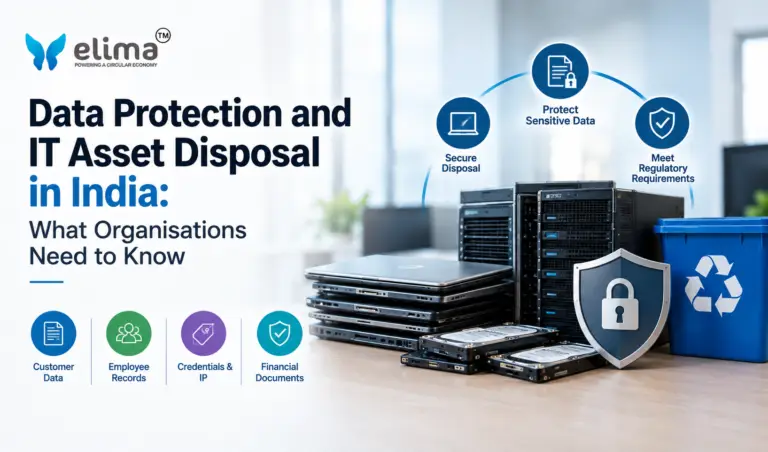
When an organisation replaces an old laptop, retires a server or decommissions a storage device, the physical asset may leave the workplace.
The data stored on it does not necessarily disappear with it.
A retired device can contain customer information, employee records, financial documents, business communications, credentials, intellectual property and other sensitive information. Even when a device is no longer connected to an organisation’s network, its storage media may still contain information that requires protection.
This makes IT asset disposal more than a physical waste-management exercise.
It is also a data-security responsibility.
India’s evolving data-protection framework has increased the focus on how organisations collect, process, store and protect personal data. This has an important implication for the end of the IT asset lifecycle: organisations need to consider what happens to information stored on physical devices when those devices are retired, transferred, refurbished, resold or recycled.
A secure IT asset disposition process brings these responsibilities together.
Table of Contents
ToggleData protection is usually associated with active IT systems.
Organisations invest in firewalls, endpoint security, access controls, encryption and monitoring to protect information while devices are being used.
But the security requirement does not automatically end when a device is retired.
Consider a laptop that has been used by an employee for several years.
It may contain:
If the laptop is subsequently refurbished or transferred to another user without appropriate data sanitisation, information from the previous user may remain accessible.
This creates a gap between digital security during use and physical asset security after retirement.
Closing that gap is an important part of modern IT asset management.
An IT asset can have several possible destinations after it leaves active service.
It may be:
Redeployed → Refurbished → Remarketed → Donated → Dismantled → Recycled
Each pathway creates different operational considerations.
If a laptop is being redeployed, the organisation needs to ensure that information belonging to the previous user is removed.
If a server is being refurbished, storage media needs to be handled securely before the equipment is transferred.
If a hard drive is being recycled, the organisation still needs to consider the information stored on it before physical processing begins.
The destination of the hardware therefore does not remove the responsibility to manage the data.
India’s approach to data protection has been evolving as digital services and data-driven businesses continue to expand.
The Digital Personal Data Protection Act, 2023 (DPDP Act) established a legislative framework for the processing of digital personal data in India.
The framework places responsibilities on organisations that process digital personal data and establishes obligations around areas such as protecting personal data and implementing appropriate safeguards.
While the Act is primarily concerned with the processing and protection of digital personal data, its implications extend across the information lifecycle.
This includes thinking about where data resides, who can access it, how it is protected and what happens when the systems or devices containing it are retired.
The practical requirements for organisations depend on the applicable law, rules, notifications and the nature of the data and processing involved.
For IT asset management teams, the broader message is clear:
Data protection does not stop at the boundary of the active IT environment.
An IT asset itself is not necessarily the focus of data-protection legislation.
The important issue is the personal data that may be stored or processed through the asset.
A laptop, server, smartphone or storage device can become part of the data lifecycle because it may contain personal information.
This means organisations should consider data protection when assets are:
The appropriate controls depend on the organisation, the information involved and the applicable requirements.
This is why data protection and IT Asset Disposition (ITAD) increasingly need to be considered together.
Secure IT asset disposal is the controlled process of retiring IT equipment while protecting the information stored on or associated with that equipment.
It involves more than simply deleting files.
A secure process can include:
The exact process depends on the type of equipment and the organisation’s security requirements.
The key principle is that data security should be built into the asset’s retirement process from the beginning.
These two approaches are often confused.
Data sanitisation is intended to make information stored on a device inaccessible or unrecoverable using an appropriate method.
This can allow the storage device to remain usable.
For example, a laptop being prepared for refurbishment may undergo an appropriate sanitisation process before it is assigned to another user.
Physical destruction involves destroying the storage medium itself.
This may be appropriate when:
The appropriate method depends on factors including the type of storage technology, data sensitivity, organisational policy and intended disposition.
The goal is not to destroy hardware unnecessarily.
The goal is to ensure that data cannot be recovered by an unauthorised party.
Data security is not only about what happens to a storage drive.
It is also about who has possession of the asset and where it goes.
Imagine an organisation retiring 5,000 laptops.
The organisation needs more than confirmation that the laptops were collected.
It needs visibility into their movement and processing.
A controlled chain of custody can help track:
This creates greater accountability throughout the asset lifecycle.
For large enterprises, traceability becomes particularly important because assets may move through multiple locations and processing stages.
Refurbishment is an important part of the circular lifecycle of IT equipment.
A device that is no longer needed by one organisation may still be useful elsewhere.
But reuse should never mean transferring the previous owner’s data along with the hardware.
Before a device enters refurbishment or redeployment, appropriate data sanitisation should be completed.
This creates a separation between:
The hardware’s next lifecycle
and
The previous owner’s information.
Once data has been appropriately removed, the physical asset can potentially continue through another useful lifecycle.
This is one of the ways secure ITAD can support both data protection and circularity.
When equipment is no longer suitable for reuse or refurbishment, it may enter the recycling process.
At this stage, the device can be dismantled and its materials separated for recovery.
However, recycling does not automatically eliminate data-security concerns.
A hard drive is still a storage medium before it is physically processed.
A server still contains storage devices.
A multifunction printer may contain internal memory or storage.
Other electronic equipment may also contain data depending on its design.
Therefore, data sanitisation or destruction should take place at the appropriate stage before the storage media reaches a point where it could be accessed during downstream processing.
A secure ITAD programme should produce a clear record of what happened to each asset.
Depending on the organisation and process, records may include:
Documentation helps create visibility between the original owner and the final destination of the equipment.
It can also help organisations demonstrate that their internal asset-management and information-security processes were followed.
The exact records required will depend on the organisation’s policies, contracts and applicable regulatory requirements.
A strong ITAD process can be organised into several stages.
1. Identify the Asset
Record the asset and establish ownership and status.
2. Classify the Data Risk
Determine what type of information may be stored on the asset and what security requirements apply.
3. Collect Securely
Move the equipment through controlled logistics channels.
4. Maintain Chain of Custody
Track the asset throughout its movement and processing.
5. Sanitise or Destroy Data
Use an appropriate method based on the storage technology and data-security requirements.
6. Assess the Asset
Determine whether the equipment can be reused, refurbished, remarketed or recycled.
7. Process the Asset
Send the equipment through the appropriate lifecycle pathway.
8. Document the Outcome
Maintain records of the asset’s data-security activity and final disposition.
This connects data protection, IT asset management and responsible end-of-life processing within a single lifecycle.
Deleting a file does not necessarily mean that the underlying information is unrecoverable.
Different storage technologies require different approaches to data sanitisation.
Printers, networking equipment, smartphones, storage systems and other devices can also contain information.
If an organisation cannot track an asset after collection, it has limited visibility into what happened to the hardware.
A device that can still be reused or refurbished may have more value as a functioning product than as a source of raw materials.
Without documentation, it can become difficult to demonstrate what happened to retired equipment.
IT Asset Disposition should not be viewed as an isolated event at the end of an asset’s life.
It is part of a broader lifecycle:
Procurement → Deployment → Use → Maintenance → Upgrade → Retirement → Recovery
Data protection exists throughout this journey.
During use, organisations protect information through technical and organisational controls.
During retirement, they need to ensure information is appropriately removed from physical assets before those assets move beyond their control.
After sanitisation, the hardware can follow the most appropriate next pathway—reuse, refurbishment, component recovery or recycling.
This makes ITAD an important bridge between information security, asset management and the circular economy.
As organisations manage increasing volumes of digital information and physical technology, the end of an IT asset’s lifecycle will require greater attention.
Data protection regulations may continue to evolve.
Technology will continue to change.
Storage systems will become more diverse.
And organisations will increasingly need to balance data security with sustainability and resource recovery.
The solution is not necessarily to destroy every retired device.
It is to build processes that can securely determine what should happen to each asset.
A working laptop can be securely sanitised and reused.
A device that needs repair can be refurbished.
A component can be recovered.
And equipment that has genuinely reached the end of its useful life can be responsibly recycled.
Data protection does not end when an organisation stops using a device. Retired laptops, servers, storage systems and other IT equipment can continue to contain information that needs to be securely managed. A well-designed ITAD process brings data sanitisation, asset tracking, controlled logistics, refurbishment and responsible recycling together so that both the information and the physical asset are handled appropriately. As India’s data-protection framework continues to develop, organisations that treat IT asset retirement as part of the complete data and asset lifecycle will be better positioned to manage both security and responsible resource recovery.