
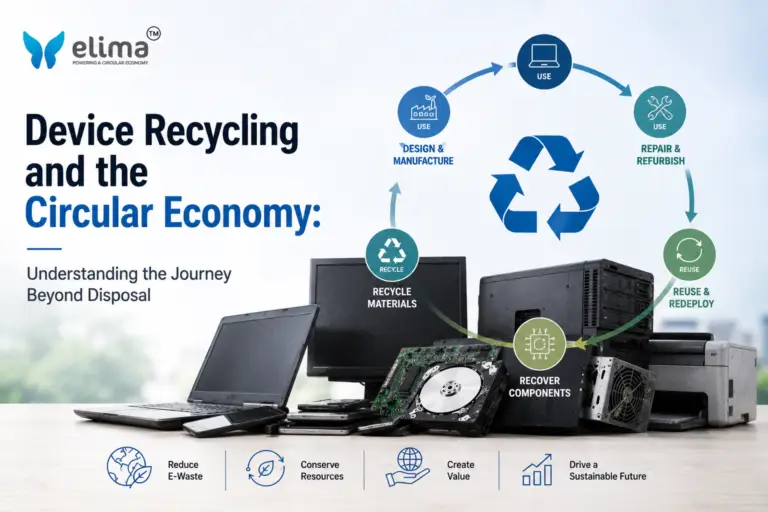
Every electronic device has a lifecycle.
It is designed, manufactured, transported, purchased, used, repaired, upgraded and eventually retired.
But retirement does not necessarily mean the end of the device’s value.
A laptop that is no longer suitable for one employee may still be useful to another. A television that cannot be repaired may contain recoverable plastics, copper and other materials. A server that has reached the end of its operational role may still contain components with residual value.
This is where device recycling becomes part of a much larger idea: the circular economy.
The circular economy looks beyond the traditional model of take, make, use and dispose. Instead, it aims to keep products, components and materials in use for as long as possible and recover their value when products can no longer serve their original purpose.
Recycling plays an important role in this system.
But it is not the whole system.
Before a device is recycled, there may be opportunities to repair, refurbish, redeploy, reuse or recover its components.
Understanding these different pathways is essential to understanding how electronic products can participate in a circular economy.
The traditional economic model has largely followed a linear pattern:
Extract → Manufacture → Use → Dispose
Raw materials are extracted, converted into products, consumed, and eventually discarded.
A circular economy takes a different approach.
Its objective is to keep products and materials circulating within the economy for as long as possible.
This can happen through:
The idea is not simply to recycle everything.
Instead, it is to preserve the highest possible value of a product or material for as long as possible.
For electronic products, this distinction is particularly important because a single device can contain a combination of functioning components, reusable materials and recoverable resources.
Electronic devices have become an integral part of modern life.
Laptops, smartphones, servers, televisions, appliances, networking equipment and other electronics are replaced regularly as technology develops and user requirements change.
At the same time, these products contain a wide variety of materials.
A single electronic device can contain:
This makes electronics an important source of secondary materials.
The scale of the challenge is significant.
The Global E-waste Monitor 2024 estimated that the world generated approximately 62 million tonnes of electronic waste in 2022. Only around 22.3% was formally collected and recycled.
The report also projects global e-waste generation could reach approximately 82 million tonnes annually by 2030 if current trends continue.
These numbers highlight an important question:
What happens to all the materials contained in these devices after their first useful life?
“End of life” does not always mean that a device has no remaining value.
It can mean different things depending on the context.
A laptop may be considered obsolete because an organisation is upgrading its workforce’s hardware.
A television may be returned because of a minor fault.
An industrial controller may no longer be compatible with a newer system.
An appliance may be replaced even though some of its components remain functional.
In each case, the next step can be different.
A device may be:
Reused → Repaired → Refurbished → Redeployed → Dismantled → Recycled → Materials recovered
This is why assessing a device before recycling is important.
The objective is to determine what the device can still offer.
Device recycling is the process of recovering materials from electronic equipment that is no longer suitable for reuse or refurbishment.
It generally involves:
Different materials require different processing methods.
Metals can be separated and processed for further use.
Plastics can be sorted according to polymer type and processed into secondary material streams.
Components may be recovered where appropriate.
The result is a shift from viewing an old device as an unwanted object to viewing it as a source of materials.
This is an important principle within the circular economy.
These terms are often used interchangeably, but they represent different stages of a product’s lifecycle.
The product continues to perform its intended function without significant intervention.
For example, an enterprise laptop may be reassigned to another employee.
A specific fault is identified and fixed so the product can continue operating.
The product is inspected, restored, tested and prepared for another period of use.
This may involve replacing components, cleaning, repairing hardware, upgrading certain elements and conducting quality checks.
The product is no longer suitable for continued use, so its materials are recovered through a recycling process.
The distinction matters because recycling should not necessarily be the first destination for every device.
If a product can safely and effectively continue functioning, extending its useful life may preserve more value than immediately dismantling it.
Once a device can no longer be reused or refurbished, the focus shifts from product value to material value.
Electronic products contain numerous materials that can potentially be recovered.
For example:
Used extensively in cables, wiring, circuit boards and electrical components.
Found in frames, housings, heat sinks and various structural components.
Used in equipment frames, enclosures and structural elements.
Used extensively in electronic housings, components and appliance parts.
Certain electronic components and circuit boards contain small quantities of materials such as gold and silver.
Recovering these materials allows them to enter new material cycles instead of being lost at the end of a product’s first lifecycle.
This is where the concept of urban mining becomes particularly relevant.
Traditional mining extracts materials from naturally occurring geological deposits.
Urban mining focuses on recovering valuable materials from products and infrastructure that already exist within society.
Electronic devices are an important source of such materials.
A city filled with retired computers, appliances, servers, networking equipment and consumer electronics effectively contains a large concentration of materials that have already been extracted, processed and incorporated into products.
The challenge is recovering those materials efficiently.
Urban mining therefore connects device recycling with the broader circular economy by turning end-of-life products into secondary sources of raw materials.
For enterprises, circularity begins long before an IT asset reaches a recycling facility.
An organisation’s IT assets typically move through a lifecycle:
Procurement → Deployment → Use → Maintenance → Upgrade → Retirement → Recovery
This is where IT Asset Lifecycle Management becomes important.
When a laptop, desktop, server or networking device is retired, organisations can evaluate whether it should be:
A structured lifecycle approach prevents every retired asset from automatically becoming a recycling case.
It also introduces other important considerations, such as:
This connects IT asset management with the principles of a circular economy.
Building a circular system for electronics is not as simple as increasing recycling rates.
Several challenges need to be addressed.
Modern electronics contain numerous materials and components, often combined in ways that make separation difficult.
New technologies and shorter upgrade cycles can cause products to become obsolete before their physical components have reached the end of their useful life.
Recycling cannot happen if products are never collected.
Efficient collection systems are therefore a critical part of the circular economy.
Different materials need to be separated effectively to produce usable secondary raw materials.
Products designed for easier repair, disassembly and recycling can make recovery significantly more efficient.
People and organisations need clear pathways for returning products once they are no longer needed.
The future of electronics is unlikely to be defined simply by producing more devices and recycling them at the end.
Instead, the focus is gradually moving toward lifecycle thinking.
Products can be designed for longer use.
Components can be repaired or replaced.
Devices can be refurbished and redeployed.
Materials can be recovered when products can no longer function.
Data can be tracked across the asset lifecycle.
And recycling can become the final stage of a much longer recovery process rather than the first response to an obsolete product.
This creates a hierarchy:
Use longer.
Repair where possible.
Refurbish when appropriate.
Recover components.
Recycle materials.
Each stage helps retain a different level of value.
Device recycling is an important part of the circular economy, but it is only one part.
A truly circular approach to electronics begins much earlier—with how products are designed, used, maintained and managed throughout their lifecycle.
When a device reaches the end of its first use, the right question is not simply:
“How do we recycle it?”
It is:
“What value can still be recovered from it?”
Sometimes that value is another period of use.
Sometimes it is a refurbished product.
Sometimes it is a reusable component.
And sometimes it is the material itself.
The circular economy depends on recognising these different possibilities and creating the infrastructure needed to act on them.
For electronic products, the journey does not necessarily end when the first user is finished with them.
It can continue through another user, another product, or another material cycle.