
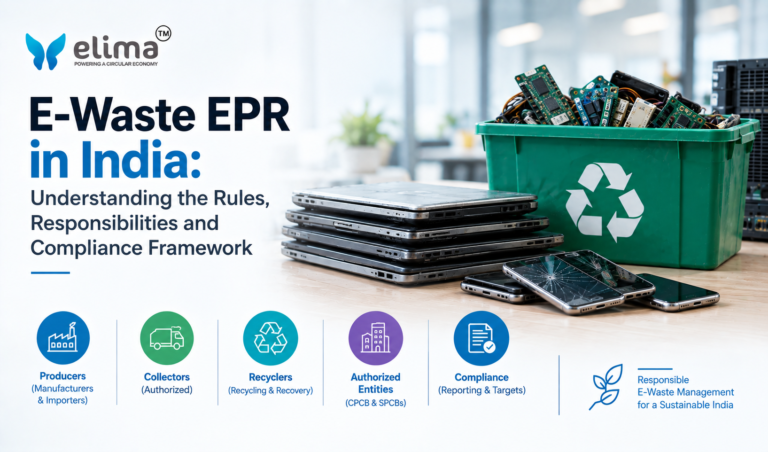
Electronic products have become an essential part of India’s economy. From smartphones and laptops to servers, appliances, networking equipment and industrial electronics, the volume and variety of electrical and electronic equipment entering the market continues to grow.
But every electronic product eventually reaches a point where it is repaired, replaced, refurbished or retired.
What happens at that stage is where Extended Producer Responsibility (EPR) becomes important.
EPR shifts part of the responsibility for a product’s post-consumer management back to the producer. In the case of electronic products, this means producers have responsibilities related to the collection and environmentally sound management of e-waste generated from their products.
India’s E-Waste (Management) Rules, 2022 established the current framework governing several stakeholders involved in the lifecycle of electrical and electronic equipment. The rules came into effect on 1 April 2023 and introduced a formal EPR framework for covered products.
For businesses operating in the electronics ecosystem, understanding EPR is therefore not simply about knowing the terminology. It means understanding who is responsible, what obligations apply, how recycling is accounted for, and how compliance fits into the larger product lifecycle.
Table of Contents
ToggleE-Waste EPR stands for Extended Producer Responsibility for electronic waste.
The basic principle is that producers should take responsibility for the environmental management of their products when those products reach the end of their useful life.
Instead of leaving end-of-life management entirely to consumers or waste handlers, EPR creates a framework that connects producers with formal collection and recycling systems.
Under India’s current e-waste framework, covered producers are required to meet specified responsibilities through the EPR system administered through the Central Pollution Control Board (CPCB).
The objective is to create a more structured system where electronic products can be collected, recycled and accounted for through formal channels.
Electronic waste is one of the fastest-growing waste streams globally.
The challenge is not simply the volume of discarded electronics.
Electronic products contain valuable materials that can be recovered, along with components that require appropriate handling.
Without formal recovery systems, materials can be lost and electronic waste can enter environmentally harmful processing channels.
EPR aims to create greater accountability across the product lifecycle.
It encourages producers to consider what happens to their products after they are sold and helps establish mechanisms for:
This makes EPR an important component of India’s broader approach to e-waste management.
The E-Waste (Management) Rules, 2022 apply to several stakeholders involved in the electrical and electronic equipment lifecycle.
These include:
Businesses involved in manufacturing electrical and electronic equipment covered by the rules have defined responsibilities under the framework.
Producers placing covered electrical and electronic equipment on the market have EPR obligations that need to be fulfilled through the prescribed system.
Registered recyclers play an important role in processing e-waste and generating recycling certificates within the regulatory framework.
Refurbishers can extend the useful life of electronic equipment and are also recognised within the regulatory framework.
The exact responsibilities vary according to the role a business performs and the products involved.
EPR obligations are not simply about collecting old electronic products.
They involve a formal system for managing and accounting for the recycling of covered products.
For producers, this can involve responsibilities such as:
The specific obligations depend on the category of stakeholder and the products covered under the rules.
Businesses should therefore evaluate their responsibilities based on their actual role in the product lifecycle rather than applying a one-size-fits-all interpretation.
The EPR ecosystem connects producers with formal recycling infrastructure.
A simplified flow can be understood as:
Product placed on market → Product used → Product reaches end of life → Collection → Recycling → Recycling certificate → EPR compliance
The process involves multiple stakeholders.
A producer places covered products on the market.
When those products eventually become e-waste, they need to enter appropriate collection and recycling channels.
Registered recyclers process the material and generate recycling certificates through the applicable regulatory system.
These certificates form an important part of the EPR accounting mechanism.
The system therefore creates a link between products placed on the market and their eventual recycling.
Recyclers are an important part of the EPR ecosystem because they provide the physical infrastructure needed to process end-of-life electronics.
A professional recycling process can include:
Registered recyclers can also play a role in generating the recycling certificates required within the EPR framework.
This makes the recycler-producer relationship important for compliance.
However, recycling should not always be the first destination for every electronic product.
Where equipment can be safely reused or refurbished, extending its useful life can preserve more value than immediately dismantling it.
One of the important features of India’s EPR framework is the use of recycling certificates.
These certificates provide a mechanism for accounting for the recycling of covered e-waste.
Registered recyclers generate certificates based on the quantity of e-waste recycled in accordance with the applicable regulatory system.
Producers can use eligible certificates to fulfil their EPR obligations as prescribed by the rules and CPCB framework.
This creates an important connection between:
Producer responsibility → Recycling activity → Documented compliance
The certificate system also helps create greater formalisation and traceability within the e-waste recycling ecosystem.
EPR compliance involves more than simply arranging for old electronics to be recycled.
Businesses need to maintain visibility into their obligations and relevant documentation.
Depending on their role, this may include:
Accurate records are particularly important when businesses manage large product volumes or operate across multiple markets.
A structured compliance process can make it easier to identify gaps and maintain consistency over time.
EPR is closely connected to the principles of the circular economy.
A linear model generally follows:
Extract → Manufacture → Use → Dispose
A circular approach attempts to keep products, components and materials in use for longer.
EPR can support this transition by creating greater accountability for what happens after products enter the market.
When end-of-life electronics are collected and processed through formal systems, several outcomes become possible:
This makes EPR more than a compliance mechanism.
It can also become part of a broader resource-recovery ecosystem.
For enterprises, EPR can intersect with IT Asset Lifecycle Management.
Businesses regularly retire laptops, desktops, servers, networking equipment and other electronic assets.
The first question should be whether the asset can continue to provide value.
It may be:
Redeployed → Refurbished → Remarketed → Component Recovery → Recycled
When equipment can no longer be reused, responsible recycling becomes the next stage.
This creates a connection between enterprise IT asset management and the wider e-waste ecosystem.
A structured IT asset lifecycle approach can help organisations maintain visibility over retired equipment while ensuring assets move through appropriate recovery or recycling channels.
For producers and organisations managing large quantities of electronics, this lifecycle perspective can also help connect operational asset management with broader environmental responsibilities.
1. What does EPR mean in e-waste management?
EPR stands for Extended Producer Responsibility. It places defined responsibilities on producers for the environmentally sound management of covered products when they reach the end of their useful life.
2. When did India’s current E-Waste Management Rules come into effect?
The E-Waste (Management) Rules, 2022 came into force on 1 April 2023.
3. Who is responsible under the E-Waste Management Rules?
The framework covers different stakeholders, including manufacturers, producers, refurbishers and recyclers, with responsibilities varying according to their role.
4. What are EPR certificates?
EPR certificates are generated through the regulated recycling system and provide a mechanism for accounting for recycling activity that can be used toward applicable EPR obligations.
5. Is recycling the only part of e-waste management?
No. A lifecycle-based approach can include reuse, repair, refurbishment, component recovery, material recovery and recycling. Recycling is one important stage within the broader lifecycle.
6. Why is documentation important for EPR compliance?
Documentation provides evidence of relevant activities and helps businesses track their obligations, recycling activities, certificates, registrations and regulatory filings.
E-waste EPR creates a structured framework for assigning responsibility for the management of electronic products after they enter the market. For businesses, understanding the framework means looking beyond recycling alone and considering the complete lifecycle of products—from use and refurbishment to collection, recycling and material recovery. As India’s electronics ecosystem continues to expand, effective EPR implementation can help strengthen formal recycling systems, improve traceability and keep valuable materials within the economy for longer. Ultimately, EPR works best when compliance and resource recovery move together, turning end-of-life electronics from a disposal challenge into part of a more circular material system.