
When electrical and electronic equipment reaches the end of its useful life, the next step is not always recycling.
A laptop may have a damaged battery but a functional processor and display. A printer may require a relatively minor repair to become usable again. On the other hand, a severely damaged circuit board or obsolete device may no longer be suitable for reuse.
This is where the distinction between refurbishment and recycling becomes important.
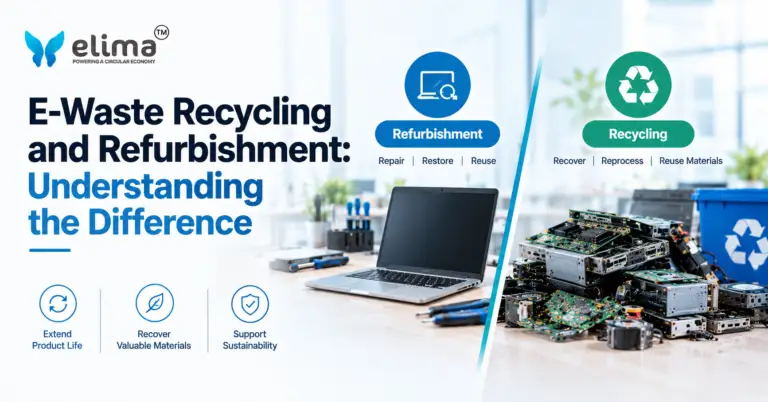
Both are important parts of responsible e-waste management, but they serve different purposes. Refurbishment focuses on extending the useful life of an existing product, while recycling focuses on recovering materials from equipment that is no longer suitable for continued use.
Understanding the difference can help businesses make better decisions about retired IT assets and electronic equipment.
Table of Contents
ToggleE-waste refers to electrical and electronic equipment that has been discarded because it is no longer wanted, required or suitable for its intended use.
Examples include:
However, an item being retired does not necessarily mean that every component within it has reached the end of its useful life.
This is why assessment is an important first step.
Refurbishment is the process of restoring used electrical or electronic equipment so that it can continue to be used.
A refurbished device may undergo some combination of:
The objective is to return the equipment to a functional condition suitable for further use.
For example, a business may retire a batch of laptops because they are no longer required by their original users. If the hardware is still functional, those laptops could potentially be tested, repaired where necessary and refurbished for another user or application.
E-waste recycling is the process of recovering materials from electrical and electronic equipment that is no longer suitable for continued use or refurbishment.
Electronic equipment can contain materials such as:
During recycling, equipment is dismantled and separated into appropriate material streams. These materials can then undergo further processing for recovery and use as secondary raw materials.
The objective is therefore different from refurbishment.
Refurbishment preserves the product.
Recycling recovers the materials.
Refurbishment | Recycling |
Focuses on extending product life | Focuses on recovering materials |
Equipment remains largely intact | Equipment is dismantled and processed |
Repairs and component replacement may be required | Materials are separated into recovery streams |
Suitable equipment can return to use | Recovered materials can return to manufacturing |
Product value is preserved | Material value is recovered |
Usually occurs before recycling | Usually applies when reuse is no longer practical |
Neither pathway is automatically suitable for every device.
The condition, age, repair cost, technical specifications, market demand and data-security requirements can all influence the decision.
Although processes vary by equipment type, refurbishment generally follows a structured sequence.
1. Collection
Used equipment is collected and recorded.
2. Inspection
The device is assessed for physical damage and overall condition.
3. Functional Testing
Key components are tested to determine whether the equipment can operate as intended.
4. Data Sanitisation
For data-bearing devices, stored information needs to be securely handled before the equipment is reused or transferred.
5. Repair
Faulty components may be repaired or replaced where economically and technically appropriate.
6. Cleaning and Restoration
Equipment can be cleaned and, where appropriate, cosmetically restored.
7. Final Testing
The refurbished equipment undergoes another round of functional testing.
8. Reuse or Remarketing
Once the equipment meets the required criteria, it can be returned to use, redeployed or remarketed.
When equipment is no longer suitable for refurbishment, it can enter a recycling pathway.
A typical process may include:
Equipment is collected and separated based on type and material composition.
Devices are dismantled into components and material streams.
Materials such as metals, plastics, circuit boards and other components are separated.
Recovered materials undergo appropriate processing to prepare them for further recovery.
Materials such as copper, aluminium, steel and engineering plastics can be recovered for use as secondary raw materials, depending on their quality and processing pathway.
The process varies considerably depending on the type of electronic equipment and the materials involved.
Refurbishment may be appropriate when:
For example, a three-year-old laptop with a worn battery may still have significant usable value if its processor, memory, display and other components remain functional.
Sending it directly for material recycling could mean losing the remaining product value.
Recycling may be more appropriate when:
In these situations, the value may lie more in the materials contained within the equipment than in the product itself.
Yes, and this is an important point.
Refurbishment and recycling are not necessarily competing processes.
Consider an old laptop.
The laptop may first be assessed to determine whether it can be refurbished. If it can, the device may be repaired and reused.
If it cannot be refurbished, the equipment can move into a recycling process.
Even during refurbishment, some components may be removed because they are defective. Those components can then enter appropriate recycling or recovery streams.
This creates a hierarchy:
Reuse → Refurbishment → Recycling → Material Recovery
The appropriate pathway depends on the condition and characteristics of the equipment.
For businesses, the distinction becomes particularly important when managing large volumes of retired IT equipment.
This is where IT Asset Disposition (ITAD) can provide a structured framework.
A typical ITAD process can include:
Asset identification
↓
Data sanitisation
↓
Condition assessment
↓
Reuse / Refurbishment / Remarketing
↓
Recycling and Material Recovery where required
ITAD therefore acts as the broader asset lifecycle process, while refurbishment and recycling represent different possible outcomes for the equipment.
Refurbishment introduces an additional consideration that is particularly important for IT equipment: data security.
A laptop, hard drive or server may contain sensitive business information even after the device has been removed from active use.
Before an asset is refurbished, organisations should establish an appropriate data sanitisation process.
Depending on the equipment and security requirements, this may involve:
This allows the asset to be prepared for its next use without treating data security as an afterthought.
Refurbishment can provide several advantages.
A functional device can continue serving a purpose instead of immediately entering material recovery.
A complete working product generally has a different value proposition from its constituent materials.
Refurbished equipment can serve organisations, users and markets that do not require new equipment.
Repairing or replacing individual components can allow the rest of the device to remain in use.
Where reuse is technically and economically viable, the product can remain in service for longer.
Recycling becomes particularly important when products can no longer be reused.
Electronic equipment contains valuable metals, plastics and other materials that can be recovered.
Recovered materials can become inputs for further manufacturing processes.
Recycling provides a pathway for equipment that is damaged, obsolete or otherwise unsuitable for reuse.
Instead of viewing an obsolete product as a single item, recycling separates it into materials with different recovery pathways.
Businesses can use a simple assessment framework.
Question | If the answer is “Yes” |
Is the equipment physically repairable? | Consider refurbishment |
Does the core hardware still function? | Consider refurbishment |
Are replacement parts available? | Refurbishment may be practical |
Is there a secondary-use market? | Consider reuse or remarketing |
Is repair more expensive than the remaining value? | Consider recycling |
Is the technology obsolete? | Evaluate recycling |
Is the equipment severely damaged? | Evaluate material recovery |
Can sensitive data be securely sanitised? | Determine whether reuse is possible |
The decision should not be based on age alone.
A five-year-old device may still have useful components, while a newer device with severe physical damage may be better suited for recycling.
At ELIMA, the assessment of retired IT assets can help determine whether equipment is suitable for continued use, refurbishment or material recovery.
The objective is to avoid treating every retired device as the same type of material.
Suitable equipment can move through assessment and refurbishment pathways, while assets that are no longer technically or economically suitable for reuse can be directed towards appropriate recovery and recycling processes.
This approach connects IT Asset Disposition, refurbishment and material recovery within a broader asset lifecycle.
For businesses, this means the decision does not have to be simply “reuse or recycle.” There can be several stages between the two, depending on the condition and potential value of the equipment.
1. Is refurbishment the same as recycling?
No. Refurbishment focuses on restoring a product for further use, while recycling focuses on recovering materials from equipment that is no longer suitable for continued use.
2. Is refurbishment better than recycling?
The appropriate pathway depends on the condition, technical viability, repair cost and potential use of the equipment. A functional device may have more value as a refurbished product, while severely damaged or obsolete equipment may be more suitable for recycling.
3. Can refurbished electronics be sold again?
Yes. Equipment that passes appropriate testing and meets the required condition can be redeployed or sold through secondary markets.
4. What happens to electronics that cannot be refurbished?
They can be directed towards appropriate dismantling, recycling and material recovery processes.
5. Why is data sanitisation important before refurbishment?
Electronic devices can contain sensitive information. Data sanitisation helps ensure that information is appropriately removed before the equipment is reused or transferred.
6. Is recycling part of ITAD?
Yes. Recycling can be one of the possible outcomes within a broader IT Asset Disposition programme.
7. Can components from a refurbished device be recycled?
Yes. Components that are removed during refurbishment may be directed into appropriate recycling or material recovery streams.
Refurbishment and recycling are two different pathways for managing electronic equipment at the end of its active use. Refurbishment focuses on keeping the product in service, while recycling focuses on recovering the materials within equipment that can no longer be practically reused.
For businesses, the important question is not simply whether an asset is “old.” It is whether the asset still has product value, whether that value can be restored, and when its remaining value is better recovered at the material level.
A well-structured approach can therefore move equipment through the right pathway at the right time, from reuse and refurbishment to recycling and material recovery. ELIMA’s approach to IT asset lifecycle management follows this principle by assessing assets before determining their next appropriate destination.