
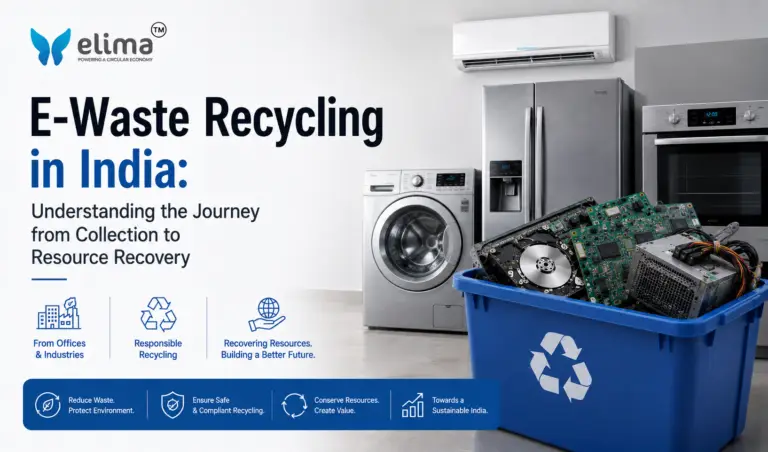
Electronic devices have become an essential part of everyday life. Businesses depend on laptops, servers, networking equipment and data centre infrastructure, while households use everything from televisions and appliances to personal computers and other connected devices.
But what happens when these products are no longer needed?
An old laptop is not simply a discarded device. It contains components, metals, plastics and other materials that can potentially be reused, refurbished or recovered. At the same time, some electronic equipment requires controlled handling because of the materials and components it contains.
This is why e-waste management in India is becoming increasingly important.
India generated around 4.1 million tonnes of e-waste in 2022, according to the Global E-waste Monitor 2024, placing the country among the world’s largest generators of electronic waste.
Managing this volume requires much more than simply increasing recycling capacity. It requires an ecosystem that can collect electronic products, assess their condition, extend their useful life where possible, recover materials and ensure responsible processing at the end of the lifecycle.
In other words, recycling is only one part of the e-waste journey.
Table of Contents
ToggleE-waste refers to electrical and electronic equipment that has been discarded because it is obsolete, damaged, replaced, or no longer required.
It can include products from both households and businesses.
Common examples include:
The important thing about e-waste is that it is not a single type of material.
A laptop, for example, can contain metals, plastics, glass, circuit boards, batteries and other components, each requiring different handling and recovery processes.
This makes electronic waste management a specialised process rather than a simple disposal activity.
India’s rapid adoption of technology has created an equally rapid increase in retired electronic equipment.
Businesses regularly refresh their IT infrastructure. Consumers replace appliances and personal electronics. Manufacturers introduce newer generations of products.
At the same time, the useful materials contained within these products remain valuable.
The challenge is creating systems that allow these materials to be recovered efficiently.
The Global E-waste Monitor 2024 estimates that global e-waste generation reached 62 million tonnes in 2022 and could rise to 82 million tonnes by 2030 if current trends continue.
India’s regulatory framework has also evolved in response to this growing challenge. The E-Waste (Management) Rules, 2022 came into force on 1 April 2023 and apply to manufacturers, producers, refurbishers, dismantlers and recyclers involved in the relevant electrical and electronic equipment lifecycle.
This makes structured e-waste recycling in India increasingly important for businesses, producers and other organisations managing electronic products.
Collection is often considered the beginning of recycling.
In reality, it is the beginning of a decision-making process.
Once electronic equipment is collected, it needs to be assessed to determine its next destination.
A product may:
Continue its first lifecycle → be repaired → be refurbished → be redeployed → enter a secondary use cycle → be dismantled → undergo material recovery
This is why professional e-waste collection should not be viewed as simply moving old electronics from one location to another.
The objective is to determine the highest-value and most appropriate next step for each asset.
A professional e-waste recycling process generally involves several stages.
Electronic equipment is collected from homes, offices, warehouses, manufacturing facilities, retail locations or other points of generation.
For enterprise assets, collection may involve large volumes of equipment across multiple locations and therefore requires coordinated reverse logistics.
Collected equipment is sorted according to product category, condition, material composition and potential for reuse or recovery.
This stage helps determine whether an asset should move toward refurbishment, component recovery or recycling.
Functional equipment may still have useful life remaining.
Testing helps identify products that can be repaired, upgraded, refurbished or redeployed rather than immediately dismantled.
For IT equipment, data security is a critical part of the process.
Laptops, desktops, servers and storage devices may contain confidential information even after they have been removed from active use.
Before these assets are refurbished, remarketed or dismantled, appropriate data sanitization processes should be completed.
Where technically feasible, equipment can be restored to usable condition.
Refurbishment may involve:
This allows a product to continue its lifecycle before its materials eventually enter the recycling stream.
Equipment that can no longer be reused or refurbished can be dismantled to recover materials.
Depending on the product, recovered materials may include:
The objective is to recover usable resources while ensuring materials that cannot be recovered are handled responsibly.
E-waste recycling centres form an important part of the infrastructure required to manage electronic products after their useful life.
However, a modern recycling facility is not simply a place where electronics are broken down.
A well-managed facility can support several stages of the lifecycle, including:
For large-scale e-waste recycling companies in India, the ability to manage these stages efficiently is essential to maintaining consistent material quality and responsible processing.
The quality of the output depends heavily on what happens before the recycling stage.
Poor collection and sorting can lead to contamination.
Better segregation can improve recovery.
Better testing can identify products suitable for refurbishment.
This means the effectiveness of a recycling system depends on the entire chain, not just the final processing stage.
Recycling is important, but it should not automatically be the first option.
Consider a five-year-old laptop.
If the device can still perform effectively after replacing a battery or another component, dismantling it immediately may mean losing the remaining functional value of the product.
Refurbishment offers another pathway.
The same principle applies to many other categories of electronics and appliances.
A useful hierarchy is:
Can the product continue to be used as it is?
Can a specific fault be fixed?
Can the product be restored for another user or application?
Can useful components be recovered from the product?
Can its materials be recovered and processed for another manufacturing application?
Only after the available higher-value pathways have been considered should the remaining materials be processed appropriately.
This lifecycle-first approach is particularly relevant to IT asset recycling, where large volumes of enterprise equipment can contain significant residual value even after the original user has retired it.
The end of the recycling process is not necessarily the end of the material’s journey.
Recovered metals can enter manufacturing supply chains.
Recovered plastics can potentially be processed into new material streams.
Components may be reused where appropriate.
This is where the concept of urban mining becomes relevant.
Electronic products contain concentrations of certain materials that originally came from natural resources. Recovering those materials from products already in circulation can create an alternative source of feedstock.
For example, electronic equipment can contain copper, aluminium and precious metals. India’s Ministry of Environment, Forest and Climate Change has reported significant gold recovery through registered e-waste recyclers, illustrating the material value present in discarded electronics.
The objective is therefore not simply to reduce what is discarded.
It is to recover what can still be used.
For businesses, e-waste management often overlaps with a much broader discipline: IT Asset Lifecycle Management.
Enterprise IT equipment passes through several stages:
Procurement → Deployment → Use → Maintenance → Upgrade → Retirement → Recovery
The retirement stage should not be treated as an isolated disposal event.
Laptops, desktops, servers, networking equipment and other IT assets may still have value when they are retired from one environment.
A structured lifecycle approach can help organisations determine:
This is where IT asset lifecycle management and e-waste recycling services increasingly intersect.
The growing number of e-waste recycling companies in India makes choosing the right partner an important consideration.
Businesses should look beyond collection and ask how the entire asset lifecycle will be managed.
Some important factors include:
The provider should operate within applicable regulatory frameworks and maintain the documentation required for its activities.
Businesses should be able to understand where their assets went and what happened to them.
For IT equipment, secure data sanitization should be a defined part of the process.
A provider should be able to assess whether an asset can be reused or refurbished before recycling.
The recycling process should focus on recovering valuable materials rather than simply reducing physical volume.
Clear documentation helps organisations maintain internal records and demonstrate responsible asset management.
India’s E-Waste Management Rules have established an EPR framework and registration requirements for relevant stakeholders, making regulatory awareness an important part of selecting an e-waste recycling company.
One of the biggest differences between informal disposal and structured e-waste management is visibility.
A business should be able to answer questions such as:
What assets were collected?
Where were they processed?
Which assets were refurbished?
Which materials were recovered?
How was data handled?
What happened to the remaining material?
Traceability connects each stage of the process.
For enterprises managing hundreds or thousands of assets, this becomes particularly important because asset management is not only about physical movement. It is also about maintaining accurate records throughout the lifecycle.
The future of e-waste management in India cannot depend on recycling alone.
It requires a broader approach.
Products need to be designed with lifecycle considerations in mind.
Collection systems need to become more accessible.
Sorting and processing infrastructure needs to improve.
Refurbishment needs to be considered before material recovery.
And materials recovered from discarded products need to find their way back into productive use.
This creates a system in which an electronic product can move through multiple stages instead of following a single path from purchase to disposal.
Collection creates access.
Refurbishment extends life.
Recycling recovers materials.
Urban mining turns those materials into resources.
That is the larger role of modern e-waste infrastructure.
India’s e-waste challenge is not simply about how much electronic waste is generated.
It is about what happens to those products after they are no longer needed.
A laptop can become a refurbished laptop.
A server can become a source of reusable components.
A discarded appliance can become a source of recovered metals and plastics.
And an electronic product that has reached the end of its useful life can still contribute materials to another manufacturing cycle.
This is why effective e-waste recycling in India needs to be viewed as part of a larger lifecycle system.
For businesses, the objective should not simply be to find somewhere to send obsolete equipment.
It should be to understand the asset, determine its highest-value next step, protect the information it contains, recover what can be reused, and responsibly process what remains.
The future of e-waste management is therefore not just about recycling more.
It is about recovering more value from every product, component and material that has already entered the economy.