
Electronic products do not stop being a producer’s responsibility when they are sold.
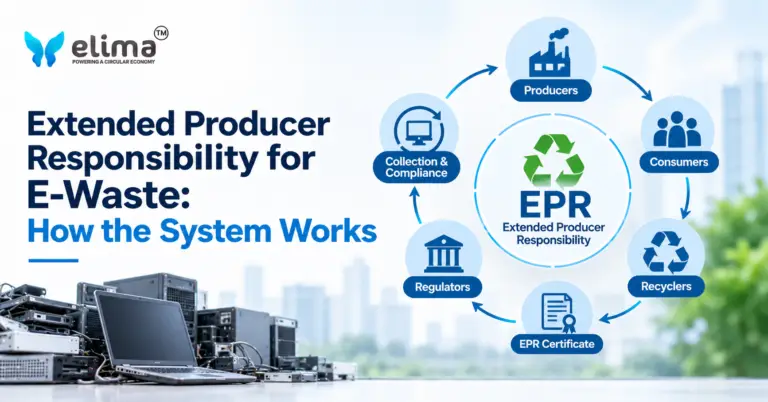
Under India’s Extended Producer Responsibility (EPR) framework, producers have defined responsibilities for managing electronic equipment after it reaches the end of its useful life. The system connects producers, recyclers, refurbishers, consumers, and regulators through registration, collection, recycling, documentation, and EPR certificates.
For businesses that manufacture or sell electrical and electronic equipment, understanding how this system works is important not only for regulatory compliance, but also for building a traceable process for retired electronics.
This guide explains the EPR system for e-waste in India, who is responsible for what, how recycling obligations are calculated, how EPR certificates work, and what businesses need to keep track of.
Table of Contents
ToggleExtended Producer Responsibility, commonly called EPR, is a regulatory approach that places responsibility on producers for managing the environmental impact of products beyond their initial sale.
For electronic equipment, this means producers have obligations relating to the collection and recycling of equipment that reaches the end of its useful life.
India’s E-Waste (Management) Rules, 2022 introduced the current EPR framework for covered electrical and electronic equipment. The rules came into effect on 1 April 2023.
The system moves beyond simply asking businesses to collect old electronics. It creates a structured framework involving:
The objective is to make the movement of electronic equipment through its end-of-life stage more organised and traceable.
Electronic equipment contains materials that can be recovered and returned to productive use, along with components that require controlled processing.
Without a structured system, there can be limited visibility into what happens after electronic products leave the hands of their users.
EPR addresses this by connecting a producer’s responsibility to measurable recycling activity.
The system encourages businesses to think about the complete product lifecycle:
Manufacture or import → Sale → Use → Collection → Recycling → Material recovery
This is particularly important as the volume and variety of electrical and electronic equipment continue to increase.
For producers, EPR also creates a clearer mechanism for demonstrating that their regulatory obligations have been addressed through authorised channels.
At a basic level, the EPR system connects a producer’s recycling obligation with recycling activity carried out by registered recyclers.
The process can be understood in six stages.
Step 1: Producer Registration
Producers covered under the E-Waste (Management) Rules must register with the Central Pollution Control Board (CPCB) through the prescribed system.
The producer provides information about its business and applicable electrical and electronic equipment.
Step 2: EPR Obligation Is Determined
The producer’s applicable EPR obligation is determined based on the rules and the relevant product and sales information.
This establishes the amount of electronic equipment for which the producer has recycling responsibility.
Step 3: Electronics Reach End of Life
Electrical and electronic equipment eventually reaches the end of its useful life.
It may come from consumers, businesses, institutions, collection channels, exchange programmes, or other authorised sources.
Step 4: Material Is Sent Through Authorised Channels
The equipment is channelled to registered recyclers for processing.
Depending on the condition of the equipment, some assets may first go through reuse or refurbishment processes.
Step 5: Recycling Takes Place
The registered recycler processes the equipment and recovers materials according to applicable requirements.
The recycling activity generates the relevant documentation and EPR certificates under the regulatory framework.
Step 6: Producer Accounts for the Obligation
The producer uses the applicable EPR mechanism to fulfil its recycling obligation and maintains the required records and returns.
This creates a link between the producer’s responsibility and actual recycling activity.
One of the most important aspects of the system is understanding that different participants have different responsibilities.
Stakeholder | Key Responsibility |
Producer | Register, meet EPR obligations, maintain records and fulfil applicable recycling requirements |
Manufacturer | Follow applicable manufacturing requirements and maintain relevant records |
Refurbisher | Register where required and maintain records of refurbishment activity |
Recycler | Process electronic equipment through authorised recycling operations and generate applicable EPR certificates |
Dismantler | Dismantle equipment according to applicable requirements and route materials through authorised channels |
Bulk Consumer | Ensure retired electronic equipment is handed over through appropriate channels and maintain relevant records |
The same company may sometimes have more than one role. For example, a business can manufacture electronic equipment and also qualify as a producer under the rules.
Understanding the exact role is therefore important before determining the applicable obligations.
Producers are at the centre of the EPR framework.
A producer generally refers to an entity that manufactures electrical and electronic equipment under its own brand, sells imported equipment under its brand, or imports electrical and electronic equipment for sale, depending on the definitions and conditions under the rules.
For covered producers, key responsibilities include:
Registration
Producers must register with the CPCB through the applicable registration mechanism.
EPR Compliance
Producers must meet their applicable recycling obligations according to the E-Waste (Management) Rules and subsequent amendments.
Working With Registered Recyclers
Recycling for EPR purposes needs to be carried out through recyclers registered under the applicable framework.
Record Keeping
Producers need to maintain relevant records and submit prescribed returns or information through the applicable regulatory system.
Product and EPR Information
Producers are required to provide relevant information and follow applicable requirements relating to their products and EPR activities.
The exact compliance requirements can change through amendments and regulatory directions, so businesses should always refer to the latest CPCB and Ministry of Environment, Forest and Climate Change requirements.
EPR does not simply mean that a producer has to collect every electronic product it has ever sold.
The framework establishes specific recycling obligations based on the applicable methodology under the rules.
The recycling targets have also been structured progressively.
For example, the CPCB’s E-Waste Rules FAQ identifies the following recycling targets for applicable producers:
Financial Year | Recycling Target |
FY 2023-24 | 60% |
FY 2024-25 | 60% |
FY 2025-26 | 70% |
FY 2026-27 | 70% |
FY 2027-28 onwards | 80% |
These percentages need to be understood in the context of the applicable calculation methodology under the rules. They should not be interpreted as a simple percentage of every product currently sold.
There are also separate provisions and methodologies for certain categories, including new producers and used electrical and electronic equipment imported into India.
This is why producers should calculate their obligations based on the applicable regulatory methodology rather than using a generic percentage.
EPR certificates are an important part of India’s digital EPR framework.
Registered recyclers generate EPR certificates based on eligible recycling activity. These certificates represent recycling that has been carried out through the regulatory system.
A producer can use applicable EPR certificates to fulfil its recycling obligation according to the rules.
This creates an important connection:
Producer obligation → Registered recycler → Recycling activity → EPR certificate → Compliance
The certificate system also creates greater visibility into recycling activity than a system based only on informal collection records.
The 2024 amendment to the E-Waste Management Rules also introduced provisions relating to the exchange or transfer of EPR certificates through the designated platform, subject to the applicable conditions.
A producer generally needs to build a process that connects its products with appropriate end-of-life channels.
A practical EPR workflow can look like this:
1. Identify Applicable Products
Determine which products fall under the scope of the E-Waste Management Rules.
2. Complete Registration
Ensure the producer is appropriately registered with the CPCB.
3. Determine the Applicable Obligation
Calculate the EPR obligation using the methodology applicable to the producer and its products.
4. Establish Recycling Channels
Work with appropriate registered recycling partners.
5. Track Recycling Activity
Maintain documentation related to quantities, recycling and EPR certificates.
6. Complete Returns and Reporting
Submit the required information and returns through the prescribed system.
7. Maintain Supporting Records
Keep documentation that allows the business to demonstrate how its EPR obligation was addressed.
This process is much easier to manage when EPR is treated as an ongoing operational process rather than an annual compliance exercise.
Registered recyclers are a critical part of the EPR ecosystem.
Their role goes beyond physically processing electronic equipment.
A recycler operating within the EPR framework is responsible for processing eligible material according to applicable requirements and maintaining records of its activities.
The recycling process can include:
For producers, choosing the right recycling partner is therefore important.
The recycler’s registration status, processing capability, documentation, traceability and reporting processes all matter.
Not every electronic device reaching the end of its first use needs to be immediately recycled.
Some equipment may still have useful life remaining.
A refurbishment process can involve:
Assessment → Repair → Testing → Data sanitisation → Quality checks → Redeployment or resale
This allows usable equipment to remain in service for longer.
However, refurbishment and recycling are different activities, and the regulatory requirements applicable to a refurbisher are different from those applicable to a recycler.
Businesses should therefore maintain clear records of what happens to equipment that enters a refurbishment channel and what eventually moves to recycling.
This distinction is also important in IT Asset Disposition, where the objective is often to determine the highest-value appropriate outcome for each asset.
Businesses and institutions that use large quantities of electrical and electronic equipment also have an important role in the system.
A bulk consumer may have large numbers of:
When these assets are retired, they should be channelled through appropriate authorised mechanisms.
For organisations, this is where IT Asset Disposition becomes particularly useful.
A structured ITAD process can help businesses maintain:
This creates a stronger connection between internal asset management and external regulatory requirements.
EPR compliance is not simply about physically sending electronic equipment to a recycler.
The business must also be able to demonstrate what happened.
Depending on the stakeholder and activity, relevant records may include:
Good documentation creates an audit trail.
For larger organisations, integrating these records with procurement, asset management, finance and compliance systems can make EPR management considerably more efficient.
Failure to meet applicable EPR requirements can create regulatory and financial consequences.
The E-Waste (Management) Rules provide mechanisms for action in cases of non-compliance, including environmental compensation and other actions under the applicable regulatory framework.
This is why treating EPR as a last-minute compliance task can create unnecessary risk.
Businesses should instead build a process around:
Registration → Obligation calculation → Recycling → Documentation → EPR certificates → Reporting
The exact consequences of non-compliance depend on the nature of the violation and the applicable provisions at the time.
Even when an organisation understands EPR conceptually, implementation can be complicated.
Businesses may handle many products across different categories, making classification an important first step.
EPR obligations are based on prescribed methodologies. Using a simple sales percentage without understanding the applicable calculation can result in errors.
Not every recycling facility is suitable for EPR compliance.
Registration, processing capability and documentation should be verified.
Moving material through multiple collection and processing channels can make it difficult to maintain a clear audit trail without proper systems.
For IT equipment, physical recycling is only one part of the process.
Storage devices can contain confidential information, making secure data sanitisation or destruction an important step before equipment moves further through the recovery process.
EPR requirements can evolve through amendments and regulatory directions.
Businesses need a process for reviewing current requirements rather than relying indefinitely on older compliance assumptions.
For businesses managing large volumes of retired IT and electronic equipment, the challenge is not only moving assets out of the organisation. It is creating a controlled process from collection to the asset’s next stage.
ELIMA’s Circulink programme supports structured IT Asset Disposition through secure collection, asset tracking, data sanitisation, assessment, refurbishment, recovery and responsible downstream processing.
The process helps organisations maintain visibility across the asset lifecycle while determining whether equipment is suitable for reuse, refurbishment or material recovery.
This approach is particularly useful for enterprises that need stronger control over asset movement, data security and documentation.
ELIMA also operates recovery and recycling capabilities supported by CPCB authorisation and ISO 9001, ISO 14001 and ISO 45001 certifications. Its operations span multiple states across India, helping organisations manage electronics recovery through a more structured national network.
The key principle is simple: an electronic asset should not lose its traceability simply because it has reached the end of its first useful life.
1. What is EPR for e-waste?
Extended Producer Responsibility is a regulatory framework that places defined responsibilities on producers for the management and recycling of covered electrical and electronic equipment after it reaches the end of its useful life.
2. Who is responsible for EPR in India?
The producer has the primary EPR responsibility under the E-Waste (Management) Rules. Manufacturers, refurbishers, recyclers, dismantlers and bulk consumers also have specific responsibilities depending on their role.
3. Is EPR registration mandatory?
Producers covered by the E-Waste (Management) Rules are required to register with the CPCB through the applicable registration mechanism.
4. What is an EPR certificate?
An EPR certificate represents eligible recycling activity carried out by a registered recycler under the applicable EPR framework. Producers can use applicable certificates to meet their recycling obligations according to the rules.
5. Can a producer meet EPR obligations through any recycler?
No. Recycling for EPR compliance needs to follow the applicable regulatory framework and involve recyclers registered under the relevant system.
6. Is refurbishment the same as recycling?
No. Refurbishment aims to restore an electronic product so that it can continue to be used, while recycling focuses on recovering materials from equipment.
7. Are bulk consumers responsible for EPR?
Bulk consumers have responsibilities relating to the appropriate handling and handover of end-of-life electronic equipment, but their responsibilities are different from the producer’s EPR obligation.
8. How often should businesses review their EPR compliance?
Businesses should monitor their obligations continuously and review regulatory requirements whenever applicable rules, amendments or CPCB directions change.
EPR creates a structured connection between the producer of an electronic product and what happens to that product after its useful life ends.
For businesses, effective EPR management means more than obtaining certificates. It requires accurate product information, appropriate recycling channels, reliable documentation, traceability and an understanding of the responsibilities associated with each stakeholder.
When these elements work together, EPR becomes part of a broader asset lifecycle process rather than a separate compliance exercise. For organisations handling significant volumes of IT and electronic equipment, that approach can make recovery, reporting and regulatory management far more controlled and transparent.