
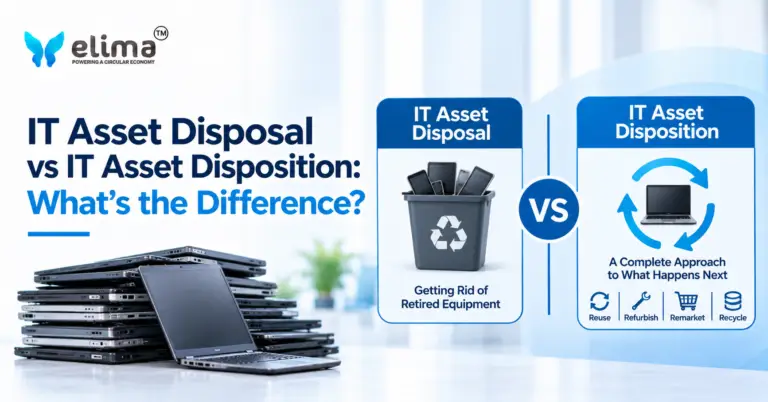
The terms IT asset disposal and IT asset disposition (ITAD) are often used to describe what happens to computers, servers, storage devices and other technology when an organisation retires them.
They sound similar, but they do not mean exactly the same thing.
IT asset disposal generally focuses on removing or getting rid of retired equipment. IT asset disposition is a broader process that looks at what should happen to each asset after retirement, including reuse, refurbishment, remarketing, component recovery and material recovery.
That distinction matters.
A retired laptop that is still functional may have considerable value. Sending it directly for material processing could mean losing the opportunity to reuse the product. On the other hand, an obsolete or damaged device may be better suited for dismantling and material recovery.
This is why modern organisations increasingly look at IT assets through a disposition approach rather than treating retirement simply as disposal.
Table of Contents
ToggleIT asset disposal refers broadly to the process of removing technology equipment that an organisation no longer needs.
This can include assets such as:
The word disposal often implies that the equipment has reached the end of its useful life and needs to be removed.
However, an important question remains:
Does the asset actually need to be disposed of, or does it still have value?
That question is what separates a simple disposal approach from a more comprehensive ITAD process.
IT Asset Disposition (ITAD) is the structured process of managing IT equipment after it is retired from active use.
Instead of assuming that every retired asset should follow the same route, ITAD evaluates each asset and determines the most appropriate outcome.
A typical ITAD process can include:
Inventory → Collection → Data sanitisation → Assessment → Reuse → Refurbishment → Remarketing → Material recovery → Reporting
The final outcome depends on the condition, age, specifications, data-security requirements and remaining value of the asset.
An organisation may therefore have several outcomes within the same ITAD programme.
For example:
ITAD is therefore less about simply removing equipment and more about managing the next stage of an asset’s lifecycle.
The easiest way to understand the difference is:
Disposal focuses on getting the asset out. Disposition focuses on deciding what should happen to the asset next.
Aspect | IT Asset Disposal | IT Asset Disposition |
Primary focus | Removal of retired equipment | Managing the asset after retirement |
Approach | Often end-focused | Lifecycle-focused |
Asset assessment | May be limited | Central to the process |
Data security | May be included | Core part of the process |
Reuse | May not be prioritised | Considered where appropriate |
Refurbishment | Usually secondary | Common disposition pathway |
Remarketing | May be included | Often part of the process |
Material recovery | Final route | One of several possible routes |
Asset tracking | Can be limited | Typically more structured |
Value recovery | Not always a primary objective | Important consideration |
Reporting | May focus on completion | Can cover the full asset journey |
The distinction is particularly important for organisations managing hundreds or thousands of IT assets.
Imagine a company is replacing 1,000 laptops.
Under a basic disposal approach, the objective might simply be:
Collect the old laptops → Remove data → Send them for processing
Under an ITAD approach, the process could be:
Collect → Record → Secure data → Test → Grade → Determine the best route
The 1,000 laptops might then be divided into different groups.
For example:
The exact numbers will vary, but the principle is important.
Not every retired asset has the same remaining value.
ITAD recognises that difference.
A basic IT asset disposal process may involve several steps.
Collection
Retired devices are collected from offices, data centres or other locations.
Data Removal
Storage devices are erased or destroyed according to the organisation’s security requirements.
Sorting
Equipment may be grouped according to type, condition or processing route.
Downstream Processing
Equipment that is no longer suitable for continued use may move to appropriate recycling or recovery channels.
Documentation
The organisation may receive records confirming collection and processing.
The exact process varies between organisations and service providers.
The limitation of a purely disposal-focused approach is that it may not give enough attention to whether an asset could have been reused or refurbished.
ITAD takes a more comprehensive approach.
Every asset is identified and recorded.
This can include:
Equipment is collected through a controlled process.
Storage media is securely erased or destroyed according to the required standard and organisational policy.
The asset is inspected and tested to determine its condition and remaining value.
Assets can be categorised according to functionality, physical condition and market suitability.
Possible routes include:
Reuse → Refurbishment → Remarketing → Component recovery → Material recovery
The selected pathway is carried out.
The organisation receives relevant records covering the asset’s disposition.
This creates a traceable process from retirement to final outcome.
One common misconception is that ITAD begins when a device reaches a recycling or processing facility.
In reality, good ITAD starts much earlier.
Organisations need to know:
This means ITAD can connect with the broader IT lifecycle.
Procurement → Deployment → Active use → Maintenance → Retirement planning → ITAD → Recovery
When ITAD is built into the lifecycle, retirement becomes a planned operational process rather than an afterthought.
One of the biggest risks associated with retired IT equipment is the information stored on it.
A laptop or server may contain:
Simply deleting files does not necessarily provide adequate protection.
Depending on the asset and organisational requirements, secure data handling may involve:
For organisations, the important point is that data security should be addressed before an asset moves into reuse, remarketing, refurbishment or material recovery.
A strong ITAD process therefore treats data security as a core stage rather than an optional add-on.
One of the biggest advantages of ITAD is that it creates opportunities to preserve product value.
Reuse
A functional device can be reassigned to another employee, department, location or user.
Refurbishment
A device may require repairs, component replacement, cleaning, testing or upgrades before it can be used again.
Remarketing
Equipment that still has commercial value can be sold into appropriate secondary markets after data sanitisation and quality checks.
These routes can help organisations recover more value from their IT investments than simply sending every retired asset directly for material processing.
Not every asset can or should be reused.
A device may be:
In these cases, material recovery may be the appropriate route.
Equipment can be dismantled and separated into different material streams, including:
These materials can then move through appropriate downstream processing.
This is why ITAD should not be understood as a process designed only to maximise resale value.
The objective is to identify the most appropriate outcome for each asset.
Question | IT Asset Disposal | IT Asset Disposition |
Is the asset removed from service? | Yes | Yes |
Is data security considered? | Can be | Yes |
Is every asset individually assessed? | Not always | Typically |
Is reuse considered? | Sometimes | Yes |
Is refurbishment considered? | Sometimes | Yes |
Is remarketing considered? | Sometimes | Yes |
Is material recovery included? | Often | Yes, where appropriate |
Is value recovery a priority? | Not necessarily | Yes |
Is chain-of-custody important? | Depends on process | Yes |
Is detailed reporting provided? | Varies | Typically |
Does it manage the full post-retirement journey? | Not necessarily | Yes |
For organisations managing a significant number of IT assets, a structured IT Asset Disposition approach generally provides a more complete framework.
This does not mean that the word “disposal” is always incorrect.
Businesses still need to dispose of equipment that has no practical reuse or refurbishment pathway.
The important difference is that disposal should ideally be the result of an assessment, rather than the default assumption.
A useful decision framework is:
1. Can the asset still be used?
If yes, consider reuse.
2. Can it be restored economically?
If yes, consider refurbishment.
3. Does it retain market value?
If yes, consider remarketing.
4. Can useful components be recovered?
If yes, consider component recovery.
5. Has it reached the end of its practical product life?
If yes, move it through appropriate material recovery channels.
This approach helps businesses match the asset with its most suitable next stage.
ELIMA’s Circulink programme is designed around a structured IT Asset Disposition approach.
The process can bring together:
Secure collection → Asset identification → Data sanitisation → Assessment → Refurbishment → Recovery → Reporting
Instead of treating every retired device as a disposal item, assets can be evaluated according to their condition and remaining value.
Functional equipment can move toward reuse or refurbishment, while assets that have reached the end of their practical service life can move toward dismantling and material recovery.
This approach also helps organisations maintain visibility across the asset journey, from collection and data security to the final disposition outcome.
For businesses managing large IT estates, the benefit is not simply getting old equipment out of the building. It is having a controlled, traceable process for determining what happens next.
1. Is IT asset disposal the same as IT asset disposition?
No. Disposal generally refers to getting rid of retired IT equipment, while disposition is a broader process that determines the most appropriate outcome for each asset, including reuse, refurbishment, remarketing and material recovery.
2. What does ITAD stand for?
ITAD stands for IT Asset Disposition.
3. Is ITAD only for computers?
No. ITAD can cover laptops, desktops, servers, storage devices, networking equipment, monitors, printers, mobile devices and other technology assets.
4. Why is ITAD better than simply disposing of old IT equipment?
ITAD evaluates the remaining value and condition of assets before determining their next step. This can create opportunities for reuse, refurbishment and value recovery while also providing stronger tracking and reporting.
5. Does ITAD include data destruction?
Yes. Secure data sanitisation or destruction is a core part of responsible ITAD for devices that contain storage media.
6. Can old IT equipment be refurbished instead of recycled?
Yes. If an asset is technically and economically suitable, refurbishment can extend its useful life before material recovery becomes necessary.
7. When should an IT asset be sent for material recovery?
Material recovery may be appropriate when an asset is obsolete, damaged, uneconomical to repair or otherwise unsuitable for continued use or secondary markets.
8. Is ITAD only relevant to large enterprises?
No. While large organisations often have more complex IT estates, businesses of different sizes can benefit from structured asset tracking, data security and controlled disposition processes.
IT asset disposal and IT asset disposition may sound like two names for the same process, but there is an important difference.
Disposal is primarily about removing an asset. Disposition is about determining what should happen to it next.
That difference changes how organisations approach retired technology. Instead of treating every device as an item to be discarded, ITAD evaluates whether it can be reused, refurbished, remarketed, recovered for components or processed for materials.
For businesses, this creates a more controlled approach to retirement, combining data security, asset visibility, value recovery and responsible downstream processing in one lifecycle process.
Ultimately, good ITAD is not about finding the fastest way to get rid of old technology. It is about making a well-informed decision about where each asset goes after its first useful life ends.