
A discarded electronic device may look like an obsolete piece of equipment.
But inside that device are materials that can continue to have value long after the product itself stops working.
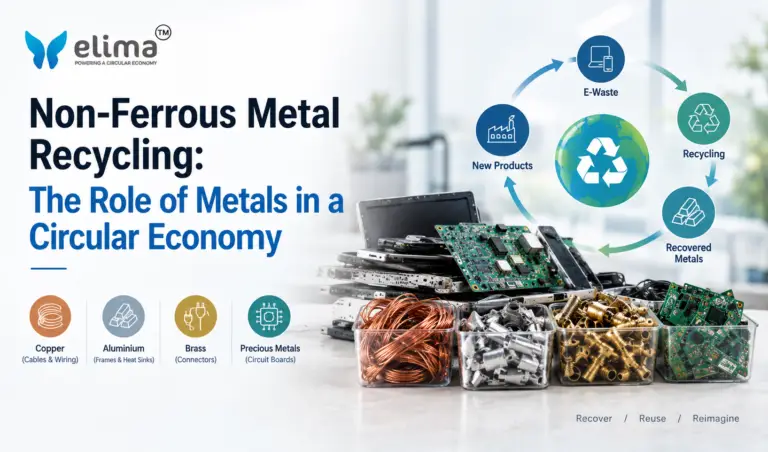
Copper in cables. Aluminium in frames and heat sinks. Brass in connectors. Precious metals in circuit boards. These materials do not necessarily lose their properties simply because the product containing them has reached the end of its useful life.
This is where non-ferrous metal recycling becomes important.
Non-ferrous metals are metals that do not contain iron as their primary component. They are widely used across electronics, automobiles, construction, electrical infrastructure and industrial equipment because of properties such as conductivity, corrosion resistance, low weight and durability.
Recovering these metals from products that are no longer in use can help keep valuable resources within the material cycle.
It also forms an important part of urban mining, where materials are recovered from products and infrastructure already present in society rather than relying entirely on newly extracted resources.
Table of Contents
ToggleNon-ferrous metals are metals that do not primarily consist of iron.
They include both common industrial metals and valuable metals used in specialised applications.
Some of the most widely used non-ferrous metals include:
These materials have different physical and chemical properties, making them suitable for different applications.
For example, copper is highly conductive, aluminium is lightweight and corrosion-resistant, while gold has excellent conductivity and resistance to corrosion.
These properties explain why non-ferrous metals are used extensively in electronic and electrical products.
Copper is one of the most important metals in electrical and electronic systems.
It is used in:
Its high electrical conductivity makes it particularly valuable for electronics and electrical infrastructure.
Aluminium is lightweight, conductive and resistant to corrosion.
It can be found in:
Its combination of low weight and durability makes it useful across many industries.
Nickel is used in alloys, batteries, electronic components and other specialised applications.
It can also be present in certain rechargeable battery chemistries.
Tin is commonly used in soldering applications and helps connect electronic components to circuit boards.
Gold and silver are used in certain electronic components because of their excellent electrical conductivity and resistance to corrosion.
Although the quantities used in an individual device may be small, large volumes of electronic equipment can collectively represent a significant source of these materials.
Modern electronic devices depend heavily on metals.
A smartphone, laptop, server or appliance can contain numerous metal components that enable the device to function.
Copper carries electrical current.
Aluminium helps manage heat and provides structural strength.
Tin is used in solder.
Nickel and other metals are used in batteries and specialised components.
Gold and silver may be present in connectors and electronic components.
This means that when electronic equipment reaches the end of its useful life, it should not be viewed solely as discarded hardware.
It can also represent a secondary source of materials.
The journey of a metal does not necessarily end when the product containing it is discarded.
Consider an old server.
The server may no longer be suitable for its original application, but it contains:
A structured recovery process can separate these materials so they can move into different processing streams.
This is where material recovery becomes important.
Instead of treating the entire product as one material, professional recycling separates it into different categories and identifies opportunities to recover as much value as possible.
The exact process varies depending on the product and metal being recovered, but professional recycling generally involves several stages.
Products are collected from households, businesses, warehouses, manufacturing facilities and other sources.
Equipment is sorted according to product type, material composition and processing requirements.
Products are dismantled to separate components and material streams.
For electronic equipment, this may involve removing circuit boards, cables, batteries, housings and other components.
Ferrous and non-ferrous materials are separated using mechanical and other specialised processes.
Non-ferrous metals can then be further separated based on their properties and composition.
Recovered materials undergo appropriate processing to produce secondary raw materials that can potentially be used in manufacturing.
Certain metals may require additional processing to achieve the purity required for their next application.
The objective throughout the process is to maximise material recovery while ensuring that different material streams are handled appropriately.
Traditional mining extracts metals from naturally occurring deposits.
Urban mining looks at another source: the materials already embedded in products, buildings, infrastructure and discarded equipment.
Electronic products are particularly interesting from an urban mining perspective because they contain a combination of common and specialised materials.
A city with millions of electronic products in use also has a large stock of materials that will eventually enter different stages of the product lifecycle.
When these products are collected and processed properly, some of those materials can be recovered and returned to productive use.
This does not mean urban mining replaces conventional mining.
Instead, it provides an additional source of materials and can help reduce the loss of resources already extracted from the earth.
A linear economic model generally follows:
Extract → Manufacture → Use → Dispose
A circular economy seeks to keep products and materials in circulation for longer.
Metal recycling fits naturally into this model.
When copper, aluminium or other metals are recovered from an old product, the material can potentially enter another manufacturing cycle.
This creates a loop:
Raw Material → Product → Use → Recovery → Secondary Material → New Product
The advantage of metals is that many can be recycled repeatedly without losing their fundamental material properties, although the quality and suitability of recovered material depend on the specific metal and processing method.
This makes metal recovery an important component of resource efficiency.
Different electronic products contain different combinations of non-ferrous metals.
May contain copper, aluminium, tin, nickel and smaller quantities of precious metals.
Can contain significant quantities of copper, aluminium and other metals across wiring, power systems, circuit boards and structural components.
Routers, switches and other networking devices contain metals within circuit boards, connectors, cables and housings.
Air conditioners, refrigerators, washing machines and other appliances can contain copper, aluminium and other recoverable materials.
Depending on their chemistry, batteries can contain materials such as nickel, cobalt, lithium and other metals.
The composition varies by product, manufacturer, model and technology generation.
India is expanding its manufacturing, electronics, renewable energy, automotive and digital infrastructure sectors.
These industries require significant quantities of metals and other raw materials.
At the same time, the country is generating increasing quantities of end-of-life electronic equipment.
The Global E-waste Monitor 2024 estimated that India generated approximately 4.1 million tonnes of e-waste in 2022, making it one of the largest generators globally.
This creates an important opportunity.
Instead of viewing end-of-life electronics only as a disposal challenge, India can increasingly view them as a source of secondary materials.
The more efficiently these materials are recovered, the more resources can potentially remain within the economy.
Recovering metals from electronic products is not always straightforward.
Modern devices contain multiple materials that are tightly integrated into small components.
Separating them efficiently requires specialised processes.
Different materials can become mixed or contaminated during collection and processing, affecting the quality of recovered material.
A recycling system cannot recover materials from products that never enter formal collection channels.
Efficient collection therefore remains an essential part of the recovery ecosystem.
Different metals require different separation and processing methods.
Recovering high-value materials may require more sophisticated technologies than basic metal separation.
The cost of collection, transportation, dismantling and processing must be balanced against the quantity and value of recoverable materials.
Improving metal recovery is not simply about increasing recycling volumes.
It is also about improving the quality of what is recovered.
Better product collection can reduce material loss.
Better sorting can improve purity.
Better dismantling can separate components more effectively.
Better processing can produce higher-quality secondary materials.
And better traceability can provide greater visibility into where recovered materials ultimately go.
This creates a more connected recovery ecosystem in which products, components and materials can move through different stages instead of being treated as disposable at the end of their first use.
For IT equipment, this approach can be integrated into IT Asset Lifecycle Management, where assets are first assessed for reuse or refurbishment before components and materials are considered for recovery.
Non-ferrous metals are too valuable to be treated as materials with a single-use lifecycle. Copper, aluminium, nickel, tin and other metals can continue to serve a purpose when recovered from products that have reached the end of their useful life.
As electronic consumption grows, non-ferrous metal recycling and urban mining can play an increasingly important role in keeping these materials in circulation. The goal is not simply to recycle more products, but to recover more of the resources already embedded within them.
A product may reach the end of its life, but its materials do not have to reach the end of theirs.