
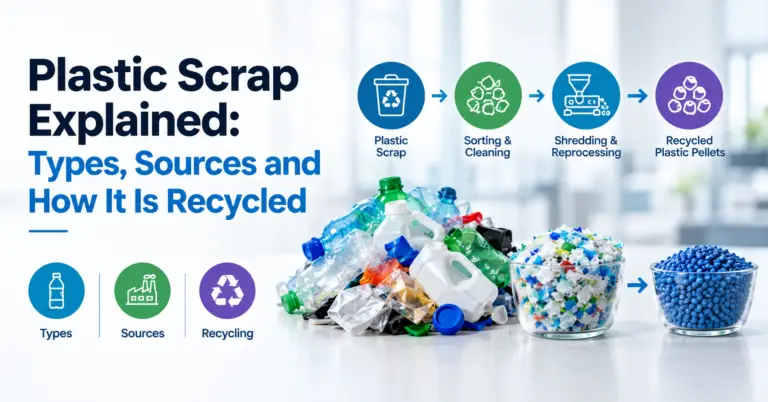
Plastic is used across almost every major industry, from packaging and consumer electronics to automobiles, appliances and manufacturing. Once a plastic product, component or material is no longer required for its original purpose, it can become plastic scrap.
But plastic scrap is not a single type of material. Different plastics have different chemical properties, applications and recycling requirements. Identifying the type of plastic is therefore one of the most important steps in determining how it can be recovered and reused.
Understanding where plastic scrap comes from, how it is classified and what happens during recycling helps businesses make better decisions about material recovery and the use of recycled plastics.
Table of Contents
TogglePlastic scrap refers to discarded or excess plastic materials that can potentially be recovered, processed and used again as raw material.
It can come from manufacturing processes, damaged products, packaging, rejected components, obsolete equipment, consumer products and end-of-life appliances.
Plastic scrap can exist in several forms, including:
The condition and composition of the material determine whether it can be directly reused, mechanically recycled, reprocessed into granules or requires more specialised treatment.
Plastic scrap is generated at different stages of a product’s lifecycle.
1. Manufacturing
Manufacturing facilities can generate plastic scrap through trimming, cutting, moulding and injection processes.
Examples include:
Because manufacturing scrap is often relatively clean and comes from a known material stream, it can be suitable for recycling and reprocessing.
2. Consumer Products
Plastic products eventually reach the end of their useful life. This includes household products, packaging, electronics, appliances and other consumer goods.
Once collected, these products may be dismantled and their plastic components separated from other materials.
3. Electrical and Electronic Equipment
Electronic equipment contains a variety of plastics used for housings, connectors, insulation and internal components.
When electronic equipment is processed through an organised recovery system, plastic components can be separated and directed towards appropriate recycling streams.
4. Appliances
Large appliances such as refrigerators, washing machines, air conditioners and dishwashers contain considerable amounts of plastic.
Their plastic components can include housings, panels, internal parts and other engineered plastic components.
The recycling process requires proper dismantling and segregation because these products contain multiple material types.
5. Packaging
Packaging is another major source of plastic scrap. Bottles, containers, films, trays and other packaging materials can enter recycling streams after use.
However, packaging plastics can vary significantly in composition, contamination level and recyclability.
One of the simplest ways to classify plastic scrap is according to the polymer from which it is made.
PET is commonly used for:
PET can be mechanically recycled into new products and fibres when collected and processed appropriately.
HDPE is known for its strength and durability.
It is commonly found in:
Recycled HDPE can be processed into granules and used in manufacturing applications where its properties are suitable.
PVC is widely used in:
PVC recycling requires careful segregation because additives and different formulations can significantly affect the material’s properties.
LDPE is flexible and is commonly used for:
Recycling LDPE can be more challenging when the material is heavily contaminated or mixed with other materials.
PP is one of the most widely used plastics across industrial and consumer applications.
It can be found in:
Recycled PP can be processed into plastic granules for use in suitable manufacturing applications.
ABS is an engineering plastic valued for its strength, impact resistance and surface characteristics.
It is commonly found in:
ABS scrap can be particularly relevant in electronic and appliance material recovery because many housings and structural components use this polymer.
Plastic scrap is also classified based on how the material behaves when heated.
Thermoplastics soften when heated and harden again when cooled.
This characteristic makes many thermoplastics suitable for mechanical recycling.
Examples include:
They can often be processed, melted and formed into new products or plastic granules.
Thermosetting plastics undergo a chemical change during their formation and cannot simply be melted and reshaped repeatedly.
Examples include certain:
Their recycling pathways are therefore different from conventional thermoplastics and may require specialised processing.
Recycling begins long before the plastic reaches a processing machine.
The first important step is collection.
Plastic scrap is gathered from manufacturing facilities, commercial operations, product recovery systems, dismantling operations and other sources.
It is then sorted according to factors such as:
Proper segregation is critical because mixing incompatible plastics can reduce the quality and usability of the recycled material.
For example, PP scrap should generally be kept separate from other polymers when the objective is to produce consistent recycled PP granules.
Although processes vary depending on the polymer and source material, mechanical plastic recycling generally involves several stages.
1. Collection
Plastic scrap is collected from manufacturing, commercial, industrial or post-consumer sources.
2. Sorting
Materials are separated based on polymer type, colour, application and other characteristics.
3. Inspection
The material is checked for contamination, foreign materials and unsuitable components.
4. Cleaning
Where required, the plastic is cleaned to remove dirt, labels, residues and other contaminants.
5. Shredding or Size Reduction
The plastic is reduced into smaller pieces to make further processing easier.
6. Washing and Drying
Depending on the material, washing may be carried out to remove remaining contaminants. The material is then dried before further processing.
7. Extrusion
The processed plastic is melted and passed through an extruder. During this stage, filtration and other controls may be used to improve material consistency.
8. Pelletising or Granulation
The processed plastic is converted into granules or pellets.
These granules can then serve as a secondary raw material for manufacturing applications where their properties meet the required specifications.
Plastic granules are small, uniform pieces of processed plastic that can be used as feedstock for manufacturing.
They are produced by processing suitable plastic scrap through stages such as sorting, cleaning, size reduction and extrusion.
Granules are easier to handle, store, transport and feed into many manufacturing processes than irregular pieces of scrap.
The quality of recycled granules depends on several factors, including:
This is why simply identifying a material as “recycled plastic” does not provide enough information about its suitability for a particular application.
The market value of plastic scrap can vary considerably depending on its characteristics.
Different polymers have different demand and applications. Clean, well-segregated material is generally easier to process than mixed plastic.
Material containing a high proportion of the intended polymer is more suitable for producing consistent recycled material.
Colour can influence the possible end applications of recycled plastic. Natural or lighter-coloured material may have different applications from mixed or dark-coloured material.
Oil, dirt, metal, labels and other contaminants can increase processing requirements and affect the quality of the output.
The condition of the material also matters. Clean production scrap, rigid components, shredded plastic and mixed post-consumer material can have very different processing requirements.
For recycled plastics intended for manufacturing, technical characteristics such as Melt Flow Index (MFI), ash content, moisture and density can be important quality indicators.
Plastic scrap management is not simply about moving discarded material from one location to another.
A well-managed material recovery process helps identify which plastics can be reused, refurbished, recycled or processed into secondary raw materials.
For businesses, this can improve:
It also creates a clearer connection between discarded products and the materials that can return to manufacturing.
Recycled plastics can serve as secondary raw materials in a wide range of applications.
Depending on their properties and quality, recycled polymers can be used in products such as:
The appropriate application depends on the technical characteristics of the recycled material.
Not every recycled plastic is suitable for every application. Understanding the polymer, processing history and quality parameters is therefore essential when integrating recycled material into manufacturing.
Plastic scrap has value when it is properly identified, segregated and processed. That is where ELIMA ReSource comes in.
ReSource is ELIMA’s portfolio of recovered metals, engineering plastics and other secondary materials prepared for manufacturing applications. For businesses looking to source recycled plastic materials, the focus is not simply on buying recycled material, but on finding material with the right specifications for their application.
ReSource includes recovered plastic materials such as PP granules, available in different grades and colours depending on the material stream and processing requirements. Parameters such as Melt Flow Index, ash content, colour and material consistency can help manufacturers assess whether a recycled polymer is suitable for their production needs.
If your business is sourcing recycled PP granules, engineering plastics or other secondary raw materials, explore the ReSource portfolio from ELIMA.
Talk to the ELIMA ReSource team to discuss your material requirements, specifications and available grades.
Choose recovered materials that are ready for their next manufacturing application.
1. Is all plastic scrap recyclable?
No. Recyclability depends on the polymer, contamination, additives, material combination and available processing technology.
2. What is the difference between plastic scrap and plastic granules?
Plastic scrap is a broad term for discarded or excess plastic material. Plastic granules are processed, uniform pieces of plastic that can be used as secondary raw material in manufacturing.
3. Which plastics are commonly recycled?
PET, HDPE, LDPE and PP are among the commonly recycled plastics. Engineering plastics such as ABS can also be recovered and recycled through appropriate processes.
4. Why is sorting important in plastic recycling?
Different polymers have different melting characteristics and technical properties. Proper sorting helps maintain the consistency and quality of recycled material.
5. What is recycled PP?
Recycled PP is polypropylene obtained by recovering and processing previously used or excess PP material. It can be converted into granules and used in suitable manufacturing applications.
6. What factors determine the quality of recycled plastic?
Polymer purity, contamination, moisture, colour, ash content, density, Melt Flow Index and processing history can all influence recycled plastic quality.
Plastic scrap is not simply discarded plastic. It is a collection of different polymer materials with different properties, sources and recovery pathways.
From manufacturing scrap and appliance components to post-consumer products, proper identification and segregation can determine whether plastic becomes a low-value mixed stream or a useful secondary raw material.
As material recovery becomes increasingly important for manufacturers, understanding plastic scrap is the first step towards using recycled polymers more effectively. ELIMA’s approach to material recovery reflects this principle: identify the material, preserve its value and find the right pathway for its next use.