
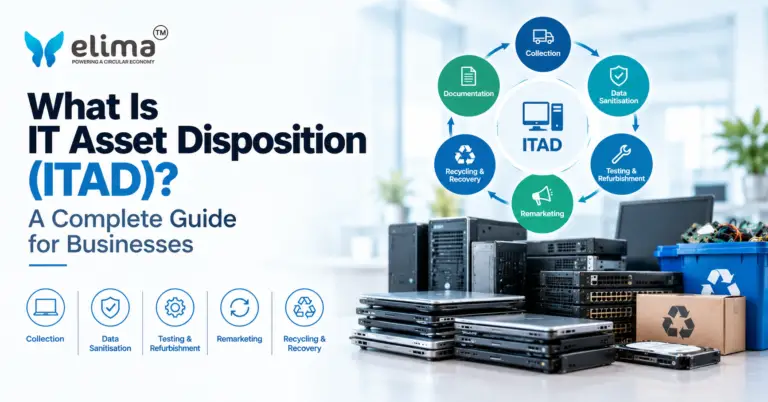
Businesses rely on technology across almost every function. Laptops, desktops, servers, networking equipment, storage devices, printers and other IT assets support everyday operations, but every device eventually reaches a point where it is replaced, upgraded, damaged or no longer required.
What happens to these assets after they leave active use is where IT Asset Disposition (ITAD) comes in.
ITAD is the structured process of managing IT assets at the end of their useful business life. It can involve asset collection, data sanitisation, testing, refurbishment, remarketing, recycling, material recovery and documentation.
For businesses, ITAD is not simply about getting rid of old equipment. It is about maintaining control over an asset from the moment it is retired until its final reuse, recovery or recycling outcome.
Table of Contents
ToggleIT Asset Disposition, or ITAD, is the process of managing IT equipment when it reaches the end of its useful or required life within an organisation.
The process can begin when an organisation decides to retire an asset and continue until the equipment is:
A structured ITAD programme provides visibility across these stages.
For example, an old laptop may no longer be suitable for its original user but could still have value after testing and refurbishment. Another device may be damaged beyond economical repair and should instead enter an appropriate recycling or material recovery stream.
ITAD helps determine the right pathway rather than treating every retired asset in the same way.
Retiring IT equipment involves more than physically removing devices from an office.
Businesses may need to consider:
Without a structured process, organisations can lose visibility once equipment leaves their premises.
An effective ITAD programme creates a controlled transition from active IT asset → retired asset → appropriate recovery pathway.
ITAD can apply to a wide range of technology assets, including:
Computing Equipment
Networking Equipment
Storage Equipment
Office and Peripheral Equipment
The exact asset mix depends on the organisation and its technology environment.
A typical ITAD programme can be divided into several connected stages.
Asset identification → Collection → Data sanitisation → Testing → Reuse/Refurbishment → Remarketing → Recycling/Material Recovery → Reporting
Not every asset follows the same route.
A functioning laptop may be refurbished and returned to use. A server may be remarketed after secure data removal. A damaged device may be dismantled so that metals, plastics and other materials can be recovered.
The objective is to identify the most appropriate pathway for each asset.
The first step is knowing exactly what is being retired.
Asset information can include:
Maintaining this information helps organisations reconcile physical assets with their internal records.
It also creates the foundation for traceability throughout the ITAD process.
Once assets are retired, they need to be collected and transported in a controlled manner.
This is particularly important when equipment contains business or personal information.
A structured process can include:
The objective is to maintain visibility from the organisation’s premises through the next stage of processing.
One of the most important aspects of ITAD is dealing with data stored on retired equipment.
Deleting files or performing a basic factory reset does not necessarily provide the same assurance as a formal data sanitisation process.
Depending on the device and business requirement, data may be securely removed using appropriate sanitisation techniques or the storage media may be physically destroyed when reuse is not appropriate.
The method should be selected based on:
Data security should therefore be treated as a core stage of ITAD, not as an optional add-on.
After data handling, equipment can be assessed to determine its condition and potential next use.
Evaluation may consider:
This assessment helps determine whether the asset should be reused, refurbished, remarketed or recycled.
Not every retired IT asset needs to be recycled.
Some equipment can continue serving a useful purpose after repair, component replacement, cleaning or software preparation.
Refurbishment can involve:
Extending the useful life of suitable equipment can preserve the value already embedded in the asset.
Equipment that is functional and suitable for another user or market may be remarketed.
Depending on the asset, this can include:
Remarketing creates another potential value recovery pathway before an asset enters material recycling.
When equipment is no longer suitable for reuse or refurbishment, it may enter a recycling or material recovery process.
IT equipment can contain materials such as:
Appropriate dismantling and processing can separate these material streams for further recovery.
This is where ITAD connects with the broader e-waste management and circular material recovery ecosystem.
A strong ITAD programme should not end when the equipment leaves the processing facility.
Businesses may require documentation covering:
The exact documentation depends on the organisation, asset type, contractual requirements and applicable regulations.
The purpose is to provide a clear record of what happened to each asset.
Data security is one of the biggest reasons organisations need a structured ITAD process.
Retired devices can contain:
Simply removing a device from the IT network does not remove the information stored on it.
A robust ITAD process should therefore define:
This creates a clear link between IT asset management and information security.
ITAD can also support an organisation’s broader compliance and governance processes.
Depending on the business, this can involve considerations around:
In India, businesses also need to understand the applicable requirements under the E-Waste (Management) Rules, 2022, along with subsequent amendments and relevant CPCB requirements.
However, ITAD and regulatory compliance should not be treated as exactly the same thing.
ITAD is a broader asset lifecycle process that can include security, reuse, refurbishment, remarketing and material recovery. Regulatory compliance is one important component within that process.
These terms are often used interchangeably, but they describe different things.
ITAD | IT Recycling |
Covers the broader end-of-life asset lifecycle | Focuses primarily on material recovery |
Includes data sanitisation | Usually begins after equipment enters the recycling stream |
Can include reuse and refurbishment | Equipment is generally processed for material recovery |
Can include remarketing | Focuses on recovering materials |
Includes asset tracking and reporting | Focuses on recycling operations |
Recycling can therefore be one stage within an ITAD programme.
E-waste management covers the handling and processing of electrical and electronic equipment that has reached the end of its useful life.
ITAD is more specifically focused on IT assets and their controlled disposition.
For example:
Laptop retirement
→ Asset identification
→ Data sanitisation
→ Testing
→ Refurbishment
→ Reuse or remarketing
If the laptop cannot be reused:
→ Dismantling
→ Material separation
→ Recycling
→ Material recovery
This shows how ITAD can connect IT operations with responsible e-waste and material recovery processes.
A well-designed ITAD programme can provide businesses with several practical benefits.
Organisations can maintain records of what was retired and what happened to each asset.
Data-bearing equipment can be handled through defined sanitisation or destruction processes.
Suitable equipment can be reused, refurbished or remarketed instead of automatically being sent for recycling.
Equipment that cannot be reused can be directed towards appropriate recycling and material recovery streams.
Documentation provides visibility across collection, processing and final disposition.
A documented process can make it easier to demonstrate how retired assets were handled and where applicable requirements were addressed.
Businesses should evaluate an ITAD partner based on more than collection capability.
Important considerations include:
Ask how data-bearing devices are sanitised or destroyed and what documentation is provided.
Understand how assets are recorded from collection through final disposition.
Check whether suitable equipment can be tested and refurbished rather than automatically recycled.
Understand what happens to assets that cannot be reused.
Review applicable registrations, authorisations, certifications and operating processes.
Ask what reports and documentation will be provided after processing.
Understand how equipment is tracked while moving between collection, processing and downstream stages.
A good ITAD partner should provide visibility across the entire process rather than simply collecting equipment and providing a final receipt.
At ELIMA, IT Asset Disposition is approached as a lifecycle process rather than a simple end-of-life disposal activity.
The process can include collection, asset assessment, data-focused handling, refurbishment and material recovery, depending on the condition and nature of the equipment.
The objective is to determine the most appropriate pathway for each asset.
A functional device may have further life through refurbishment or reuse. Equipment that cannot be economically recovered can move into appropriate dismantling and material recovery streams.
This approach allows ELIMA to connect ITAD with refurbishment, e-waste management and material recovery, while maintaining a focus on asset traceability and responsible downstream processing.
For organisations managing large volumes of retired IT equipment, a structured ITAD programme can provide a clearer way to manage what happens after an asset leaves active use.
1. What does ITAD stand for?
ITAD stands for IT Asset Disposition. It refers to the structured process of managing IT equipment when it is retired, replaced or no longer required.
2. Is ITAD the same as IT recycling?
No. IT recycling is primarily concerned with recovering materials from equipment. ITAD is broader and can include data sanitisation, reuse, refurbishment, remarketing, recycling and reporting.
3. Why is data destruction important in ITAD?
Retired devices can still contain sensitive information. A formal data sanitisation or destruction process helps reduce the risk of information remaining accessible after an asset leaves organisational control.
4. Can old IT equipment be refurbished?
Yes. Suitable equipment can often be tested, repaired and refurbished for continued use or remarketing.
5. What happens to IT equipment that cannot be refurbished?
Equipment that is no longer suitable for reuse can be dismantled and processed through appropriate recycling and material recovery channels.
6. What is the difference between ITAD and e-waste management?
ITAD focuses specifically on the controlled disposition of IT assets, while e-waste management covers a broader range of electrical and electronic equipment and its end-of-life processing.
7. How does ITAD help businesses?
A structured ITAD programme can help businesses maintain asset visibility, manage data security, recover value from suitable equipment, improve traceability and direct end-of-life assets into appropriate recovery pathways.
IT Asset Disposition is more than the final step in an IT asset’s lifecycle. It connects asset management, data security, refurbishment, value recovery, compliance and material recovery into one structured process.
The right approach is not to treat every retired device as identical. Some assets can be reused, some can be refurbished or remarketed, and others can be dismantled for material recovery.
As businesses continue to manage growing volumes of technology assets, a well-defined ITAD process can help ensure that the end of an asset’s operational life does not mean the end of its value. ELIMA’s approach brings together asset assessment, refurbishment and material recovery to create a more structured pathway for retired IT equipment.