
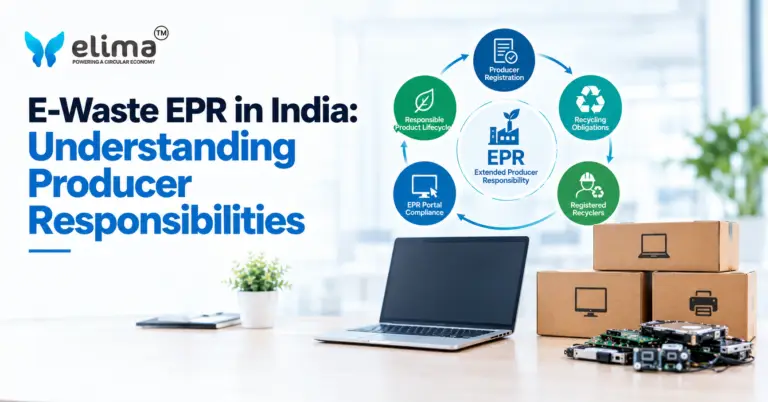
India’s approach to electronic waste management has increasingly moved towards Extended Producer Responsibility (EPR), placing defined obligations on producers of electrical and electronic equipment.
Under the E-Waste (Management) Rules, 2022, EPR is linked to the responsibility of producers for meeting prescribed recycling obligations through registered e-waste recyclers. Producer registration and EPR compliance are managed through the Central Pollution Control Board’s EPR portal.
For manufacturers and brands selling electrical and electronic equipment in India, understanding EPR is therefore an important part of managing the product lifecycle.
But what exactly does EPR mean for a producer? What needs to be registered? How are recycling obligations calculated? And what role do registered recyclers play?
This guide breaks down the key responsibilities.
Table of Contents
ToggleExtended Producer Responsibility, or EPR, is a regulatory approach that places responsibility on producers for meeting prescribed recycling obligations for covered electrical and electronic equipment.
Under the E-Waste (Management) Rules, 2022, CPCB defines EPR as the responsibility of a producer for meeting recycling targets through registered e-waste recyclers to ensure environmentally sound management of e-waste.
In practical terms, the system creates a connection between:
Producer → EPR obligation → Registered Recycler → Recycling → EPR Certificate
The producer is responsible for meeting the applicable obligation, while registered recyclers perform the physical recycling and generate eligible certificates through the prescribed system.
The rules define a producer in relation to electrical and electronic equipment covered under the framework.
Broadly, a producer can include an entity that:
The exact applicability depends on the definition and categories specified under the E-Waste (Management) Rules, 2022.
Businesses should therefore determine their status based on the actual nature of their activities rather than assuming that every seller of electronic products has identical obligations.
Electrical and electronic products contain materials that can be recovered, but they can also contain substances that require controlled management.
The EPR framework creates a formal mechanism to connect products placed on the market with their eventual recycling obligations.
The objective is to create greater accountability around:
The framework also provides a digital system through which stakeholders can manage registrations, obligations and certificates.
Producer registration is a key requirement for entities covered by the producer definition.
CPCB states that producer registration is mandatory for producers covered under the E-Waste (Management) Rules, 2022, including producers of electrical and electronic equipment and their listed components, consumables, parts and spares under Schedule I.
The registration is handled through the CPCB’s EPR portal.
This means a producer cannot simply manage EPR informally through a private recycling arrangement and assume that this alone satisfies the regulatory framework.
The producer needs to operate within the prescribed registration and EPR system.
The central responsibility is to meet the applicable EPR recycling obligation.
This involves:
The obligation is therefore both quantitative and procedural.
It is not enough to simply send some old equipment to a recycler. The recycling activity needs to fit within the prescribed EPR framework.
The E-Waste (Management) Rules provide phase-wise recycling obligations.
CPCB’s published FAQ states that for producers, EPR obligations were set at:
Financial Year | Recycling Obligation |
FY 2023-24 | 60% of applicable waste generation |
FY 2024-25 | 60% of applicable waste generation |
FY 2025-26 | 70% of applicable waste generation |
FY 2026-27 | 70% of applicable waste generation |
FY 2027-28 onwards | 80% of applicable waste generation |
For producers that have recently started selling products, Schedule IV provides a separate methodology based on historical sales. CPCB states that this starts at 15% of the relevant historical sales figure for FY 2023-24, 20% for FY 2024-25, and 20% of the sales figure from two financial years earlier from FY 2025-26 onwards. Used EEE imports have a separate 100% obligation based on the quantity imported.
These calculations can vary depending on the producer’s circumstances, product category and sales history, so businesses should use the applicable Schedule and current CPCB guidance rather than relying on a generic percentage.
Under the current framework, producers fulfil their EPR obligations through the prescribed EPR system and registered recyclers.
A simplified process looks like this:
↓
↓
↓
↓
↓
CPCB specifically states that producers meet their EPR obligations by purchasing EPR certificates from registered e-waste recyclers through the EPR portal.
An EPR certificate is a certificate generated through the prescribed EPR system based on eligible recycling activity.
The certificate provides the mechanism through which recycling performed by registered recyclers can be connected to a producer’s EPR obligation.
CPCB has also specified documentation requirements for recyclers generating EPR certificates. These include records of sales and purchases of recovered end products and e-waste, supported by GST-linked invoices.
For producers, this makes the credibility and documentation of the recycling partner particularly important.
Registered recyclers are an important part of the EPR framework because physical recycling is what generates the eligible recycling activity behind EPR certificates.
A recycler’s responsibilities can include:
This is why producers should not treat recycler selection as simply a collection decision.
The recycler needs to be appropriately registered and capable of providing the documentation required under the EPR framework.
EPR compliance involves more than registration.
Depending on the producer’s circumstances and applicable requirements, records can relate to:
Good documentation helps create a traceable link between the producer’s obligation and the recycling activity used to meet it.
For businesses with large product portfolios, maintaining accurate records can also make EPR reporting more manageable.
The E-Waste (Management) Rules provide mechanisms for addressing non-compliance.
The framework includes provisions relating to environmental compensation and action for contravention.
The rules have also evolved through amendments. In November 2024, the provision relating to “Prosecution” was replaced with “Action for Contravention”, following changes to the Environment (Protection) Act framework.
For producers, this reinforces the importance of treating EPR as an ongoing compliance responsibility rather than a one-time registration exercise.
India’s EPR system has continued to evolve since the 2022 Rules came into force.
Amendments during 2023 addressed areas including the management of refrigerants associated with refrigeration and air-conditioning equipment and certain hazardous-substance provisions.
The March 2024 amendment introduced provisions relating to a platform for the sale and purchase of EPR certificates between obligated entities and provided for relaxation of certain return-filing timelines by the Central Government under specified circumstances.
A further amendment in November 2024 replaced the earlier prosecution provision with provisions concerning action for contravention.
The practical takeaway for producers is that EPR compliance needs periodic review. Businesses should work from the latest rules, notifications and CPCB guidance rather than relying on older EPR checklists.
These terms are sometimes used interchangeably, but they do not necessarily describe the same regulatory role.
A manufacturer is concerned with the manufacture of electrical and electronic equipment.
A producer, under the E-Waste Rules, is a defined regulatory category that can include entities that manufacture, sell under their own brand or import covered equipment.
One company can fall under both categories depending on its activities.
This distinction matters because EPR obligations are specifically attached to the producer role.
A producer places covered electrical and electronic equipment on the market and has the prescribed EPR responsibilities.
A bulk consumer, by contrast, is an organisation that uses covered electrical and electronic equipment at scale.
CPCB states that bulk consumers do not have to register on the EPR portal. However, they must ensure that e-waste generated by them is handed over through the appropriate channels specified under the rules.
For example, a large organisation using thousands of laptops is not automatically a producer simply because it owns those devices.
Its responsibilities are different from those of the company that placed the equipment on the market.
Producers can use the following checklist as a starting point:
Determine Applicability
Confirm whether the business and its products fall under the producer definition and Schedule I.
Register
Complete the applicable CPCB EPR registration.
Identify Product Categories
Map products to the appropriate equipment categories.
Calculate Obligations
Determine the applicable EPR obligation using the prescribed methodology.
Work With Registered Recyclers
Ensure recycling is carried out through registered e-waste recyclers as required.
Track Certificates
Maintain records of eligible EPR certificates used to meet obligations.
Maintain Documentation
Keep sales, recycling, invoice and other relevant records.
File Returns
Complete applicable reporting and returns within the prescribed timelines.
Review Regulatory Updates
Monitor amendments, CPCB guidance and changes to portal requirements.
For producers, fulfilling EPR obligations ultimately depends on having credible downstream recycling and recovery channels.
ELIMA operates within the broader IT asset lifecycle and material recovery ecosystem, with capabilities spanning collection, assessment, refurbishment and recovery of materials from retired IT assets and electronic equipment.
For businesses managing retired equipment, this creates a connection between IT Asset Disposition, refurbishment, e-waste processing and material recovery.
For producers and organisations evaluating downstream partners, the important consideration is to ensure that the selected partner’s registration, role and documentation align with the applicable regulatory requirements.
EPR compliance is ultimately about more than moving material to a recycler. It is about creating a documented and traceable connection between the producer’s responsibility and eligible recycling activity.
1. What is EPR in e-waste management?
EPR stands for Extended Producer Responsibility. Under India’s E-Waste (Management) Rules, 2022, it places defined recycling responsibilities on producers of covered electrical and electronic equipment.
2. Is producer registration mandatory?
CPCB states that registration is mandatory for producers covered by the E-Waste (Management) Rules, 2022.
3. Who is responsible for meeting EPR targets?
The producer is responsible for meeting its applicable EPR obligation through the prescribed system and registered e-waste recyclers.
4. Can a producer use an unregistered recycler for EPR compliance?
The EPR framework requires producers to meet their recycling obligations through registered e-waste recyclers.
5. Do bulk consumers need to register on the EPR portal?
CPCB states that bulk consumers do not need to register on the EPR portal. They do, however, have responsibilities concerning the appropriate handover of e-waste generated by them.
6. What is an EPR certificate?
It is a certificate generated through the EPR system based on eligible recycling activity and used by producers towards applicable EPR obligations.
7. How often do EPR requirements change?
The framework has been amended since the 2022 Rules were introduced, including amendments in 2023 and 2024. Producers should therefore check the latest MoEFCC notifications and CPCB guidance when assessing current compliance requirements.
E-Waste EPR places a clear responsibility on producers to account for the recycling of covered electrical and electronic equipment through the prescribed regulatory framework. Registration, recycling obligations, registered recyclers, EPR certificates and documentation all form part of that system.
For producers, the practical challenge is not simply understanding the term EPR. It is building a process that connects products placed on the market with documented and eligible recycling activity.
As India’s EPR framework continues to evolve, keeping registrations, calculations, certificates and downstream partnerships aligned with the latest requirements will remain an important part of responsible product lifecycle management. ELIMA can form part of the downstream recovery ecosystem by connecting retired equipment with assessment, refurbishment and appropriate material recovery pathways.