
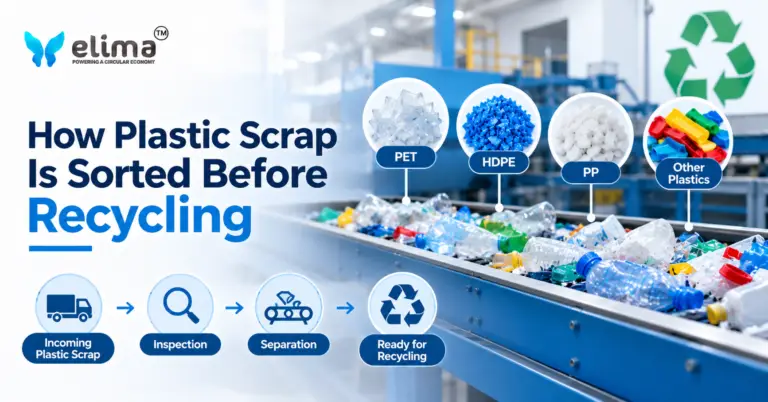
Plastic scrap rarely arrives at a recycling facility as a perfectly uniform material stream.
It can contain different polymer types, colours, shapes, sizes, additives and levels of contamination. A single collection load may contain several kinds of plastic that cannot simply be processed together.
That is why sorting is one of the most important steps before plastic recycling.
The objective is to separate incoming plastic into consistent material streams so that each type can be processed appropriately. Better sorting can improve material purity, processing efficiency and the quality of the recovered plastic produced at the end of the process.
But sorting is not always as simple as looking at a plastic item and identifying what it is made from. Professional sorting can involve a combination of source information, visual inspection, physical separation and material identification technologies.
This article explains how plastic scrap is sorted before recycling, what characteristics recyclers look for, and why proper segregation matters for manufacturing applications.
Table of Contents
ToggleDifferent plastics have different chemical structures, processing temperatures and physical properties.
For example, polypropylene (PP), high-density polyethylene (HDPE), ABS and PET cannot simply be mixed together and expected to produce a consistent recycled material.
If incompatible plastics enter the same processing stream, they can affect:
Sorting helps create more uniform feedstock before the material enters processes such as shredding, washing, extrusion and granulation.
The basic principle is:
Better segregation at the beginning → Better control during processing → More consistent recovered material
Sorting is not based on polymer type alone.
A recycling facility may evaluate several characteristics, including:
Characteristic | Why It Matters |
Polymer type | Different plastics require different processing conditions |
Colour | Helps create consistent output and affects potential applications |
Size and form | Supports efficient handling and processing |
Contamination | Foreign materials can reduce recovered material quality |
Moisture | Can affect processing and final properties |
Additives and fillers | Can change material characteristics |
Source | Helps indicate likely composition and material history |
Grade | Different grades of the same polymer can behave differently |
The more consistent the incoming material, the easier it is to create a defined output specification.
The sorting process begins when plastic material arrives at the processing facility.
The incoming material is inspected to understand:
Source information can be particularly useful.
For example, a segregated stream of PP components from a manufacturing process may already have a relatively consistent polymer composition.
A mixed collection stream containing packaging and consumer products may require much more detailed sorting.
The material can then be directed into appropriate sorting areas.
Before plastics are separated by polymer type, obvious non-plastic materials may need to be removed.
These can include:
Some separation can happen manually, while equipment such as magnetic separators can assist with removing ferrous metals.
Removing foreign material early helps protect downstream equipment and improves the quality of the plastic stream.
This is one of the most important stages.
Common plastics found in industrial and post-consumer streams include:
Polypropylene (PP)
Commonly found in:
High-Density Polyethylene (HDPE)
Commonly found in:
Low-Density Polyethylene (LDPE)
Commonly associated with:
Acrylonitrile Butadiene Styrene (ABS)
Commonly used in:
Polyethylene Terephthalate (PET)
Commonly found in:
Polystyrene and HIPS
Often used in:
Each polymer has different processing characteristics, so keeping these materials separated can be essential for producing consistent recovered material.
Colour is another important sorting criterion.
A material stream may be separated into:
Why does colour matter?
Because once different colours are mixed and processed together, achieving a consistent final colour can become difficult.
For some applications, colour consistency is an important purchasing specification.
For others, mixed-colour material may be acceptable.
Therefore, colour sorting depends partly on the intended application of the recovered plastic.
Plastic scrap can arrive in many physical forms:
Separating different forms can improve handling and processing efficiency.
For example, flexible films may require a different processing setup from rigid injection-moulded components.
Similarly, large plastic parts may need to be reduced in size before further sorting or processing.
Even after polymer and colour sorting, the material may contain contaminants.
These can include:
The appropriate removal method depends on the type of contamination.
Possible processes include:
Not every plastic stream requires washing.
Clean industrial plastic collected directly from a manufacturing process may require significantly less cleaning than post-consumer material.
Modern plastic recovery facilities can use a combination of manual and automated methods.
Workers visually inspect and separate materials based on characteristics such as:
Manual sorting can be particularly useful for complex material streams where human identification is still effective.
Larger or more advanced facilities may use technologies such as:
Near-infrared, or NIR, technology can help identify polymers based on how they interact with infrared light.
It can distinguish between certain plastic types and automatically direct them into separate streams.
Once a material has been identified, controlled air streams can separate selected pieces based on their physical characteristics.
Different plastics have different densities. In appropriate systems, this property can help separate certain polymers.
No single sorting technology is suitable for every plastic stream.
The right combination depends on the incoming material and the required output quality.
Several methods can be used to identify plastic.
Resin Identification Codes
Many plastic products carry resin identification symbols that indicate the polymer family.
These markings can provide useful information, but they should not always be treated as the only basis for industrial sorting.
Product and Source Information
Knowing where the material came from can help identify its likely polymer.
For example, a manufacturer may already know that a particular production stream consists of a specific grade of PP.
Visual Identification
Experienced sorting teams can identify certain materials based on appearance, texture, rigidity and product characteristics.
Instrument-Based Identification
Technologies such as NIR spectroscopy can provide more reliable polymer identification for suitable material streams.
In industrial recovery, multiple information sources may be used together to achieve better segregation.
Once the plastic has been properly segregated, it can move into the next stages of processing.
A typical sequence is:
Sorting → Shredding → Washing where required → Drying → Further separation → Extrusion → Filtration → Granulation → Testing
Shredding
Large plastic components are reduced into smaller pieces.
Washing
Where required, material is cleaned to remove dirt and other contaminants.
Drying
Moisture is reduced before thermal processing.
Extrusion
The plastic is melted and processed through an extruder.
Filtration
The molten material can pass through filtration systems to remove remaining impurities.
Granulation
The processed plastic is converted into granules or pellets.
Testing
The finished material can be evaluated against relevant specifications.
Depending on the polymer and application, testing may include parameters such as:
Poor sorting can create problems throughout the recycling process.
Inconsistent Polymer Composition
Mixing incompatible plastics can affect the properties of the final material.
Colour Variation
Mixed colours can produce inconsistent output.
Processing Problems
Different polymers melt and flow differently, making uncontrolled mixtures difficult to process consistently.
Contamination
Metal, dirt or other foreign materials can damage equipment or reduce material quality.
Reduced Application Potential
Material with inconsistent properties may be unsuitable for applications that require tighter specifications.
This is why sorting should not be viewed as a preliminary housekeeping step.
Sorting directly influences the quality of the material that comes out at the end.
For manufacturers purchasing recovered plastic, the question is usually not simply:
“Is this recycled plastic?”
The more useful questions are:
This is particularly important when recovered plastic is being used in injection moulding, extrusion or other controlled manufacturing processes.
A manufacturer may require a specific combination of polymer, MFI, colour and other properties.
That means sorting and quality testing are closely connected.
For recovered materials to be useful in manufacturing, consistency matters.
ELIMA’s ReSource portfolio includes recovered metals, engineering plastics and other secondary materials prepared for re-entry into manufacturing supply chains.
For plastics, appropriate segregation can help separate materials according to characteristics such as polymer type, colour and grade before further processing.
The resulting material can then be evaluated based on specifications relevant to potential manufacturing applications, including parameters such as MFI, ash content and other quality characteristics.
This approach helps move the conversation beyond simply collecting plastic and toward producing defined secondary materials that manufacturers can evaluate against their requirements.
For businesses looking for recovered PP granules, engineering plastics or other secondary materials, ELIMA ReSource can help match available material grades and specifications with manufacturing needs.
1. Why is plastic sorting necessary before recycling?
Different plastics have different chemical and processing characteristics. Sorting helps create more consistent material streams and reduces contamination before processing.
2. How are plastics sorted?
Plastic can be sorted manually or through technologies such as optical identification, NIR sorting, density separation, magnetic separation and air separation.
3. Can different types of plastic be recycled together?
Some compatible materials may be processed together in specific applications, but many polymers require separate processing to maintain consistent material properties.
4. How do recyclers identify different plastics?
Identification can involve resin markings, product and source information, visual inspection and instrument-based technologies such as near-infrared spectroscopy.
5. Is colour important when sorting plastic?
Yes. Colour affects the consistency and potential applications of the final recovered material. Whether strict colour separation is required depends on the intended application.
6. Does all plastic need to be washed?
No. Washing depends on the condition and source of the incoming material. Clean, segregated industrial plastic may require little or no washing, while more contaminated material may require extensive cleaning.
7. What happens after plastic is sorted?
Sorted material can be shredded, washed where required, dried, extruded, filtered, granulated and tested to produce recovered plastic suitable for selected applications.
8. What is MFI and why does it matter?
Melt Flow Index indicates how a thermoplastic flows under specified test conditions. Manufacturers can use MFI as one factor when evaluating whether a recovered plastic is suitable for a particular processing method.
Sorting is one of the most important steps in plastic recycling because the quality of the final recovered material depends heavily on the quality of the material entering the process.
Separating plastics by polymer type, colour, form, contamination and grade allows each material stream to be processed more appropriately. The better the segregation, the greater the control over downstream processing and final material properties.
For manufacturers, this makes sorting more than a recycling step. It is part of the process of turning mixed plastic scrap into a defined secondary material with known characteristics.
From collection and segregation to granulation and testing, every stage contributes to the quality of the final material. That is what makes effective plastic recovery useful not only for handling discarded material, but for creating inputs that can return to manufacturing.