
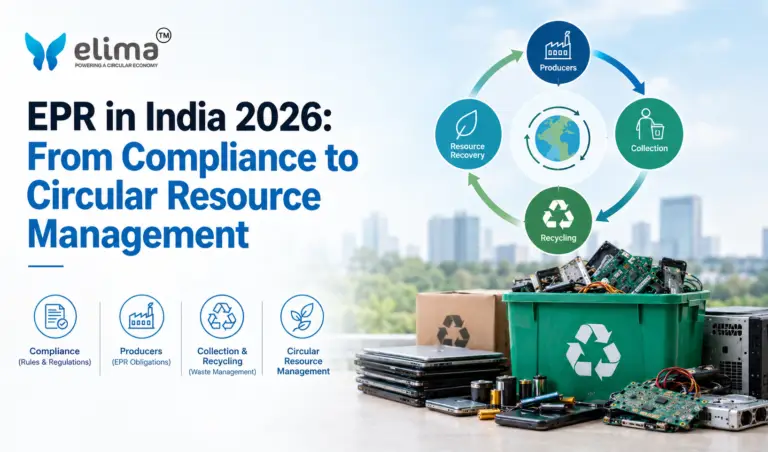
Products do not disappear when they are sold.
A plastic package may become waste after a single use. A battery eventually reaches the end of its usable life. An electronic device may be replaced after several years. A vehicle component may be recovered or recycled long after the original product has left the market.
This raises an important question:
Who is responsible for what happens to a product after its useful life ends?
This is the question that Extended Producer Responsibility (EPR) attempts to address.
EPR shifts responsibility for the post-consumer management of certain products towards the producers that place them on the market. Instead of treating waste management as something that begins only after a product becomes waste, EPR connects the product’s lifecycle with collection, recycling and resource recovery.
In India, EPR has become an increasingly important part of environmental regulation, with frameworks covering areas such as electronic waste, plastic packaging and batteries.
As these systems continue to evolve, businesses need to understand not only their compliance obligations but also how EPR fits into the larger movement towards responsible resource management and a circular economy.
Table of Contents
ToggleExtended Producer Responsibility, commonly known as EPR, is an environmental policy approach that makes producers responsible for managing certain products during their post-consumer stage.
The principle is relatively simple:
If a business places a product on the market, responsibility for that product can extend beyond the point of sale.
Depending on the applicable regulations, this can include responsibilities related to:
The exact requirements depend on the type of product and the EPR framework applicable to it.
The broader objective is to encourage producers to account for the environmental impact of products beyond their initial use.
Global consumption of products and resources continues to increase.
At the same time, waste streams are becoming more complex.
Electronic products contain multiple materials and components.
Plastic products can be difficult to recover when they are contaminated or mixed.
Batteries contain materials that require appropriate handling and recovery.
These challenges cannot be addressed effectively through disposal alone.
EPR attempts to create a more organised system in which the businesses placing products on the market are connected to the systems responsible for managing those products after use.
This creates a link between:
Production → Consumption → Collection → Recovery → Recycling
The approach also creates incentives to improve collection and recycling infrastructure and increase the amount of material that can be recovered.
India has introduced separate regulatory frameworks for different waste streams rather than relying on one universal EPR system.
Some of the most significant frameworks include:
These frameworks establish responsibilities for different stakeholders and use mechanisms such as registration, recycling obligations, reporting and certificates.
The E-Waste (Management) Rules, 2022, for example, introduced an EPR framework for covered electrical and electronic equipment and came into force on 1 April 2023.
Similarly, the Battery Waste Management Rules, 2022 established an EPR framework for producers of batteries, including requirements related to collection, recycling and recovery.
This means businesses cannot treat EPR as one universal checklist.
Their obligations depend on the products they manufacture, import, sell or otherwise place on the market.
EPR applies differently depending on the material and product category.
Understanding these differences is essential for businesses operating across multiple industries.
The electronics sector deals with products that contain metals, plastics, circuit boards, batteries and other components.
EPR requirements for covered electrical and electronic equipment focus on ensuring that e-waste enters appropriate recycling systems.
Plastic packaging represents another major EPR stream.
The framework focuses on the collection, recycling and management of plastic packaging waste and includes different categories of packaging.
Batteries require specialised collection and recycling because they contain materials that can be recovered and, depending on the chemistry, require controlled handling.
The Battery Waste Management Rules establish EPR responsibilities for producers and create mechanisms for recycling and recovery.
The growth of electronic consumption has made e-waste one of the most important areas of EPR implementation.
India’s E-Waste (Management) Rules, 2022 apply to covered electrical and electronic equipment and establish responsibilities for producers, manufacturers, refurbishers and recyclers.
For producers, the framework includes EPR obligations linked to the recycling of covered e-waste.
This creates a structured relationship between producers and registered recyclers.
The basic lifecycle can be understood as:
Product placed on market → Product used → Product reaches end of life → Collection → Recycling → EPR accounting
However, a lifecycle-based approach should also consider whether products can be reused or refurbished before they enter the recycling stage.
This is particularly relevant for IT equipment.
A retired laptop, for example, may still have useful life remaining even though it is no longer required by its original user.
Plastic packaging is another major area where EPR has become an important part of India’s waste-management framework.
Plastic packaging can be categorised into different types based on its characteristics and use.
The EPR framework creates responsibilities around the collection and management of plastic packaging waste.
One of the broader objectives is to improve the recovery of plastic materials and reduce the amount entering uncontrolled disposal pathways.
For businesses, this means understanding not only the packaging they place on the market but also the applicable EPR obligations associated with those products.
Batteries are increasingly important as the adoption of electric vehicles, portable electronics, energy storage systems and other battery-powered technologies grows.
Unlike many conventional waste streams, batteries can contain materials that require specialised collection, handling and recycling.
The Battery Waste Management Rules, 2022 introduced an EPR framework that places responsibilities on producers and connects those obligations with recycling and recovery.
Battery recycling can recover materials such as:
The exact materials depend on the battery chemistry.
This makes battery EPR closely connected with resource recovery and the development of secondary raw-material streams.
Although the details vary between waste streams, an EPR system can generally be understood through several stages.
A producer manufactures or imports a covered product and places it on the market.
The applicable rules determine the producer’s responsibilities based on the product category and relevant criteria.
Products or waste generated from those products enter formal collection and recycling systems.
Registered or authorised entities process the material according to the applicable framework.
Recycling and recovery activities are recorded through the applicable regulatory mechanisms.
Producers use the prescribed mechanisms to demonstrate fulfilment of their EPR obligations.
This structure creates accountability between products entering the market and their eventual recovery.
EPR is often discussed as a compliance requirement.
But its physical outcome depends on what happens to the waste itself.
A certificate or record does not physically recycle a product.
Collection, sorting, dismantling, processing and material recovery are what transform discarded products into secondary resources.
This distinction is important.
A strong EPR system therefore needs both:
Regulatory accountability
and
Physical recovery infrastructure
The two have to work together.
As EPR systems become more structured, traceability becomes increasingly important.
Businesses need visibility into questions such as:
Digital systems can help organisations maintain this information and create clearer records across the product lifecycle.
For large organisations, traceability can also help connect EPR activities with broader sustainability, procurement and asset-management processes.
EPR and the circular economy are closely connected, but they are not the same thing.
The circular economy focuses on keeping products, components and materials in use for as long as possible.
EPR creates a framework for assigning responsibility for certain products after they enter the market.
Together, they can support a more circular lifecycle.
For example:
Product → Use → Reuse → Repair → Refurbishment → Recycling → Material Recovery → New Product
The objective is to avoid treating the end of a product’s first life as the end of its material value.
For electronic equipment, this can mean assessing whether an asset can be reused or refurbished before sending it for recycling.
For materials such as plastics and metals, it can mean recovering them so they can become secondary raw materials.
EPR should not be treated as a once-a-year compliance exercise.
Businesses need to understand how their products move through their entire lifecycle.
Some useful questions include:
What products are we placing on the market?
Understanding product categories is the starting point for determining applicable requirements.
Which EPR framework applies?
Different waste streams have different rules and obligations.
How are end-of-life products collected?
A compliance framework needs to connect with actual collection systems.
Who is processing the material?
Working with appropriate registered or authorised entities is an important part of responsible waste management.
Can products be reused or refurbished?
Not every product reaching the end of its first use needs to be immediately recycled.
Can materials be recovered?
When products can no longer be reused, material recovery becomes important.
Can the entire process be documented?
Traceability and documentation help connect physical recovery with regulatory compliance.
The evolution of EPR in India reflects a broader shift in how products and waste are viewed.
A product is no longer simply something that is manufactured, sold and eventually discarded.
Its lifecycle can continue through reuse, refurbishment, recycling and material recovery.
This perspective is particularly relevant for electronics.
A retired laptop may still be a usable asset.
A damaged server may still contain recoverable components.
A discarded circuit board may contain valuable metals.
A used battery may contain materials that can be recovered and processed again.
EPR creates one part of the framework needed to make these recovery pathways more organised and accountable.
Extended Producer Responsibility is becoming an increasingly important part of how India manages products after they enter the market. As EPR frameworks continue to evolve across electronics, plastics, batteries and other sectors, businesses need to look beyond compliance paperwork and understand the physical lifecycle of the products they place in the market. Effective collection, responsible recycling, refurbishment, material recovery and traceability all contribute to a stronger EPR ecosystem. Ultimately, the purpose of EPR is not simply to assign responsibility for waste, but to create systems where products and materials can remain useful for longer and return to the economy instead of being lost.