
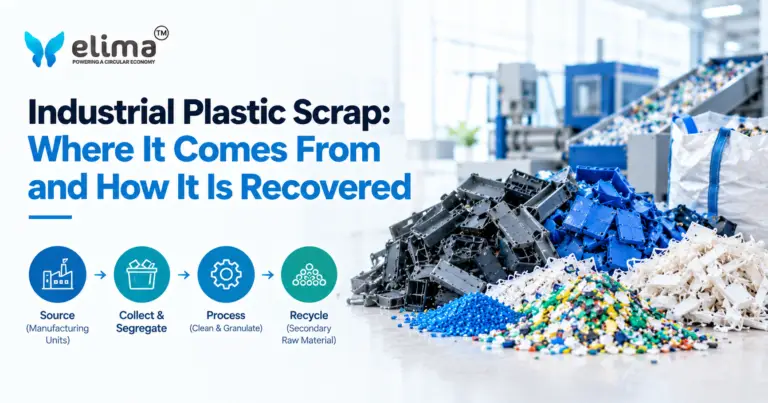
Plastic plays an important role in modern manufacturing. It is used in automotive components, electrical equipment, appliances, packaging, machinery, consumer products and countless industrial applications.
But manufacturing also generates plastic scrap.
Off-cuts, rejected components, moulding residues, production runners, damaged parts and obsolete plastic components can all become part of an industrial plastic scrap stream.
Unlike mixed post-consumer plastic, industrial plastic scrap can often have a known origin and identifiable polymer composition. This can make it particularly suitable for organised recovery when it is properly segregated and processed.
The challenge is not simply collecting the material. The real value lies in identifying, separating, processing and preparing the plastic for its next application.
Table of Contents
ToggleIndustrial plastic scrap refers to plastic material generated through industrial, manufacturing or commercial operations that is no longer required in its original form but may still have recovery value.
It can include:
The material can vary considerably in polymer type, colour, physical form and technical properties.
Common polymers found in industrial plastic streams include:
The recovery process depends on the characteristics of the particular material.
Industrial plastic scrap can originate from several points within the product lifecycle.
1. Injection Moulding
Injection moulding operations can generate:
Where the material is clean and the polymer is known, it can potentially be separated and reprocessed.
2. Manufacturing Off-Cuts
Manufacturing processes involving cutting, shaping or trimming can generate plastic off-cuts.
These materials may have relatively consistent composition because they originate from a defined production process.
3. Automotive Manufacturing
Plastic is extensively used in automotive components.
Industrial plastic scrap can include:
The recovery pathway depends on the polymer, additives and condition of the material.
4. Electrical and Electronics Manufacturing
Electronic products use plastics for:
Manufacturing rejects and end-of-life electronic equipment can therefore contribute to industrial plastic recovery streams.
5. Appliance Manufacturing
Household appliances contain significant quantities of plastic components.
Examples include:
Plastic housings and internal components can potentially be separated during dismantling and directed into appropriate recovery streams.
6. Packaging Manufacturing
Packaging production can generate:
The recovery potential depends on the polymer and contamination level.
Industrial plastic scrap is not one uniform material category.
Polypropylene is commonly found in automotive components, packaging, appliances and industrial products.
Recovered PP can be processed into recycled material such as PP granules when appropriate.
ABS is an engineering plastic commonly used in electronic housings, appliance components and consumer products.
Its strength and impact resistance make it useful in many applications, while its identifiable polymer characteristics can make segregated ABS streams suitable for specialised recovery.
HDPE is used in containers, industrial products, pipes and various moulded components.
Clean HDPE scrap can potentially be reprocessed into recycled HDPE material.
LDPE is commonly associated with flexible products and films.
Its recovery can become more challenging when the material is contaminated or mixed with incompatible polymers.
Industrial equipment and electronics can contain higher-performance plastics such as:
These materials require greater attention to identification and quality because their technical properties can vary significantly.
One of the biggest factors affecting industrial plastic recovery is material segregation.
Consider a manufacturing facility producing PP components.
If the clean PP scrap is collected separately, the material can be processed as a relatively consistent stream.
If that same scrap is mixed with ABS, PVC, metal pieces and contaminated material, additional sorting becomes necessary and the potential quality of the recovered material may decrease.
Segregation helps improve:
For industrial operations, segregation at the point of generation can therefore make the recovery process considerably more efficient.
A typical recovery pathway can look like:
Collection → Identification → Sorting → Cleaning → Shredding → Drying → Extrusion → Granulation → Testing → Secondary Use
The exact stages vary depending on the material.
Clean production scrap may require relatively little cleaning, while plastic recovered from used equipment may require dismantling, separation and more extensive preparation.
The first step is collecting the material and determining what it is.
Information may include:
Material identification is particularly important for engineering plastics and mixed industrial streams.
The material is separated into appropriate streams.
Sorting can be based on:
The objective is to create material streams that can be processed consistently.
Industrial plastic can contain materials that are not part of the polymer itself.
These may include:
Removing these contaminants helps protect processing equipment and improve the quality of the recovered plastic.
Large plastic components can be shredded into smaller pieces.
Size reduction creates a more manageable feedstock for subsequent processing and can improve the efficiency of washing, separation and extrusion.
The appropriate particle size depends on the material and processing system.
Where necessary, the shredded plastic is washed to remove surface contamination.
After washing, it is dried to reduce moisture before thermal processing.
Not every industrial plastic stream requires intensive washing. Clean manufacturing scrap may require minimal cleaning compared with used plastic components.
Prepared plastic is fed into an extruder where it is heated and melted.
The molten plastic can pass through filtration systems that help remove remaining impurities before it is formed into a consistent output.
Processing conditions are adjusted according to the polymer and desired material characteristics.
The extruded plastic is converted into small pellets or granules.
These granules provide manufacturers with a more consistent and manageable form of secondary raw material.
For example, appropriately processed PP scrap can become recycled PP granules for suitable manufacturing applications.
Recovered plastic intended for manufacturing should be evaluated against relevant specifications.
Depending on the material and application, testing may include:
Testing helps determine whether the recovered material is suitable for a particular manufacturing process.
Once properly processed, recovered industrial plastic can become a secondary raw material.
Depending on its characteristics, it may be used in:
The suitability of recycled plastic depends on the technical requirements of the end product.
A recycled polymer should therefore be selected based on its specifications rather than simply its polymer name.
Several factors can influence the quality and potential applications of recovered industrial plastic.
Polymer Purity
A clearly identified and well-segregated polymer stream is generally easier to process consistently.
Contamination
Foreign materials can affect processing and final product quality.
Processing History
Repeated heating and processing can influence the properties of some plastics.
Additives
Fillers, pigments, flame retardants and other additives can affect how a material behaves during processing.
Colour
Colour can influence the potential applications and appearance of the final product.
Melt Flow Index
MFI can provide useful information about the flow behaviour of thermoplastic materials under specified test conditions.
For manufacturers, these characteristics help determine whether a recovered plastic is appropriate for their process.
Industrial and post-consumer plastic can have very different recovery characteristics.
Industrial Plastic Scrap | Post-Consumer Plastic |
Often comes from known processes | Comes from consumer use |
Polymer may be easier to identify | Material can be mixed |
Can have relatively predictable composition | Contamination can vary |
May require less cleaning | May require more extensive cleaning |
Can be easier to segregate at source | Collection and sorting can be more complex |
Often generated before the product reaches consumers | Generated after consumer use |
This does not mean industrial plastic is always easier to recycle.
Engineering plastics, composites, additives and multi-material components can still present significant processing challenges.
Businesses generating industrial plastic scrap can improve recovery by building material management into their production and asset lifecycle processes.
Segregate at the Point of Generation
Keep different polymers separate wherever practical.
Identify the Material
Maintain information about the polymer, product and source.
Keep Valuable Streams Clean
Prevent avoidable contamination from entering otherwise recoverable material.
Track Quantities
Maintain records of the amount and type of plastic being generated.
Define Material Specifications
If recovered material will be purchased or reused in manufacturing, establish the required technical parameters.
Work With Appropriate Recovery Partners
Select processing partners based on the material type, volume and intended application.
These steps help move plastic management from simple collection towards structured material recovery.
ELIMA ReSource focuses on recovered materials prepared for use as secondary raw materials, including engineering plastics and other recovered material streams.
For industrial plastic scrap, the emphasis is on preserving material value through appropriate identification, segregation, processing and quality assessment.
Recovered plastics such as recycled PP granules and engineering plastics can then be evaluated against the requirements of manufacturers looking for secondary raw materials.
For businesses looking to source recovered plastics, ReSource provides an opportunity to evaluate materials based on factors such as polymer type, grade, colour and relevant technical specifications.
Looking for recycled PP granules, engineering plastics or other recovered materials for your manufacturing process? Talk to the ELIMA ReSource team about your material requirements and available grades.
1. What is industrial plastic scrap?
Industrial plastic scrap is plastic material generated through manufacturing, industrial operations, product processing or equipment recovery that is no longer required in its original form but may still have recovery value.
2. Where does industrial plastic scrap come from?
It can come from injection moulding, manufacturing off-cuts, automotive production, electronics, appliances, packaging and other industrial processes.
3. Is industrial plastic scrap recyclable?
Many industrial plastic streams can be recovered, but recyclability depends on the polymer, contamination, additives, material combinations and available processing technology.
4. What is the most important step in industrial plastic recovery?
There is no single step, but accurate identification and segregation are particularly important because they influence the quality and consistency of the downstream material.
5. What are recycled plastic granules?
They are small, uniform pieces of processed recycled plastic that can be used as secondary raw material in suitable manufacturing applications.
6. Can plastic recovered from electronics be recycled?
Yes. Plastic components from electronic equipment can potentially be recovered after appropriate dismantling, identification and separation.
7. What is the difference between industrial plastic scrap and post-consumer plastic?
Industrial plastic scrap generally originates from manufacturing or industrial operations and can have a more identifiable source and composition. Post-consumer plastic comes from products after consumer use and can involve more variable contamination and material mixtures.
Industrial plastic scrap can come from almost every stage of manufacturing, from injection moulding and production off-cuts to electronic equipment, appliances and automotive components.
What happens next depends largely on how well the material is identified, segregated and processed. Clean, well-characterised plastic streams can be converted into secondary raw materials such as recycled granules and engineering plastics for suitable manufacturing applications.
The goal is not simply to collect more plastic scrap, but to recover more of the material’s usable value. Through ReSource, ELIMA connects recovered plastic materials with potential manufacturing applications, helping industrial plastic move from a production by-product to a usable secondary raw material.