
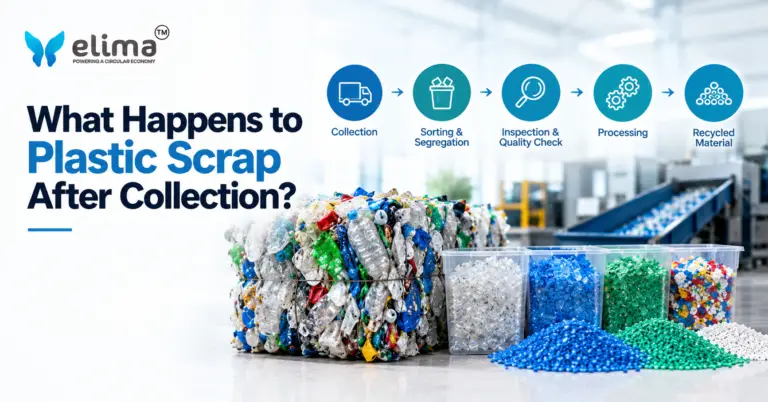
Collecting plastic scrap is only the beginning of the recycling process.
Once plastic scrap reaches a recycling or material recovery facility, it needs to be identified, sorted, inspected and processed before it can become a usable secondary raw material. The exact process depends on the type of plastic, its condition, contamination level and intended end use.
A mixed load of plastic scrap may contain several polymer types, colours and product components. Processing these materials correctly is what determines whether they can be converted into useful recycled material.
Understanding what happens after collection also helps businesses understand why segregation, quality control and traceability are important in plastic recycling.
Table of Contents
ToggleAfter collection, plastic scrap typically moves through a series of processing stages:
Collection → Inspection → Sorting → Cleaning → Shredding → Washing → Drying → Extrusion → Granulation → Testing → Secondary Use
Not every plastic stream goes through exactly the same process.
For example, clean manufacturing scrap may require significantly less processing than mixed post-consumer plastic. Engineering plastics recovered from electronic equipment may also require a different approach from packaging materials.
The objective is to turn a heterogeneous material stream into a more consistent secondary raw material.
When plastic scrap arrives at a processing facility, the first step is generally to receive and record the material.
Depending on the operation, information may include:
Recording the incoming material helps maintain traceability throughout the processing cycle.
It also makes it easier to separate different material streams before processing begins.
The collected plastic is inspected to understand what is actually present in the incoming material.
The inspection may identify:
This stage is important because plastic that looks similar visually may have very different chemical and processing characteristics.
For example, PP and another polymer may appear similar but behave differently during melting and processing.
Plastic identification is one of the most important stages of recycling.
Common polymers found in recovered plastic streams include:
Identification may be based on product markings, source information, physical characteristics and specialised testing methods.
The more accurately materials are identified, the easier it becomes to create a consistent recycling stream.
Before the plastic can be processed, unwanted materials need to be removed.
These may include:
For plastic components recovered from appliances and electronic equipment, this stage can also involve separating the plastic component from screws, wires, circuit boards and other parts.
Removing contamination improves the quality of the material going into subsequent processing stages.
After sorting, plastic components may be shredded or otherwise reduced in size.
The objective is to convert irregular pieces into a more manageable and relatively consistent feedstock.
Size reduction can make subsequent:
more efficient.
The required particle size depends on the type of material and the processing equipment being used.
Some plastic streams require washing before further processing.
Washing can help remove:
After washing, the plastic needs to be adequately dried.
Moisture can affect the processing behaviour and quality of certain recycled plastics, particularly during extrusion.
However, not every plastic stream requires the same level of washing. Clean industrial or manufacturing scrap may need considerably less cleaning than contaminated post-consumer material.
After cleaning, additional sorting may be carried out to improve material consistency.
This can involve separating plastics based on:
Quality checks can also be performed to determine whether the material meets the requirements for further processing.
This stage is especially important when the final output is intended to be sold as a secondary raw material for manufacturing.
Once the plastic has been properly prepared, suitable material can be processed through an extruder.
Inside the extruder, the plastic is heated and melted. The molten material passes through a controlled system that can include filtration to remove remaining unwanted particles.
Extrusion helps transform processed plastic flakes or smaller pieces into a more consistent material suitable for granulation.
The processing conditions depend on the polymer being handled.
The extruded plastic is converted into small, uniform pieces known as plastic granules or pellets.
These granules are easier to:
For manufacturers, granules provide a more consistent form of secondary raw material than irregular pieces of plastic scrap.
For example, recovered PP can be processed into recycled PP granules that may be suitable for specific manufacturing applications depending on their technical properties.
Producing granules is not the final step.
Recycled plastic intended for manufacturing may need to be tested for properties such as:
These parameters help manufacturers determine whether a recycled material is appropriate for their process.
For example, two batches of recycled PP may both be described as PP granules but have different processing characteristics and therefore different potential applications.
Once processed and tested, recycled plastic granules can become secondary raw materials for manufacturing.
Depending on their properties, they may be used in products such as:
The final application depends on the grade, polymer, technical specifications and manufacturing requirements.
Recycled plastic should therefore not be viewed as a single uniform category.
Not every collected plastic item can be converted into a usable recycled polymer.
Some materials may be:
The appropriate downstream pathway depends on the material and available processing technology.
This is another reason why segregation at the source can make a significant difference.
Plastic recycling becomes considerably more complicated when different polymers are mixed together.
Consider a manufacturing facility generating PP scrap.
If PP components are collected separately and kept free from incompatible materials, the resulting material stream can be easier to process into a consistent recycled PP product.
If the same material is mixed with several polymers, metals and other contaminants, additional sorting and processing may be required.
Good segregation can therefore improve:
Businesses generating plastic scrap can improve recovery by taking a few practical steps.
Identify Plastic Types
Understand which polymers are being generated and where they originate.
Segregate at Source
Keep different polymer types separate wherever practical.
Avoid Unnecessary Contamination
Prevent oils, food residues, metals and other materials from entering clean plastic streams.
Maintain Material Records
Track quantities, sources and material categories.
Work With Appropriate Recovery Partners
Choose processing partners based on the type of plastic being generated and the required downstream application.
Understand Material Specifications
If recycled granules are going back into manufacturing, define the technical specifications required by the production process.
These steps can make the transition from plastic scrap to secondary raw material more predictable.
ELIMA ReSource focuses on recovered materials that can serve as secondary raw materials for manufacturing.
For plastic streams, this can include materials such as recycled PP granules and engineering plastics, where the material has been appropriately recovered, processed and characterised.
The important part is the connection between the recovered material and its next application.
For manufacturers looking to source recycled plastics, ReSource provides a route to explore recovered material based on factors such as polymer type, grade, colour and applicable technical specifications.
If your business is looking for recycled PP granules, engineering plastics or other secondary raw materials, the ReSource portfolio can be evaluated against your manufacturing requirements.
Talk to the ELIMA ReSource team about your material requirements and explore available recovered plastic grades for your next manufacturing application.
1. What happens to plastic scrap after it is collected?
Plastic scrap is typically inspected, sorted, cleaned where necessary, shredded, processed, extruded and converted into granules or other recycled forms. The exact process depends on the type and condition of the material.
2. Is all collected plastic converted into granules?
No. Some plastics may not be suitable for mechanical recycling or granulation because of contamination, mixed polymers, degradation or other technical limitations.
3. Why is plastic sorting important?
Different polymers have different properties and processing requirements. Sorting helps create cleaner and more consistent material streams.
4. What are recycled plastic granules?
They are small, uniform pieces of processed recycled plastic that can be used as secondary raw material in suitable manufacturing applications.
5. What is Melt Flow Index?
Melt Flow Index, or MFI, is a measure used to indicate how easily a thermoplastic material flows under specified test conditions. It is an important parameter when evaluating certain recycled plastics for manufacturing.
6. Can plastic from electronic equipment be recycled?
Yes. Many electronic products contain recoverable plastics. The material needs to be properly separated from metals, circuit boards and other components before appropriate processing.
7. Does every plastic stream need to be washed?
No. The cleaning requirement depends on the source and condition of the material. Clean manufacturing scrap may require less cleaning than contaminated post-consumer material.
Plastic recycling does not end when plastic scrap is collected. Collection is the starting point of a process that can involve sorting, identification, cleaning, size reduction, extrusion, granulation and quality testing.
The quality of the final recycled material depends heavily on what happens at each stage, from how accurately the original scrap is segregated to how carefully the processed material is tested.
When these steps are managed properly, plastic scrap can move from a discarded material stream into a useful secondary raw material. Through ReSource, ELIMA connects recovered plastics with potential manufacturing applications, helping preserve the value of materials beyond their original use.